
Capstones
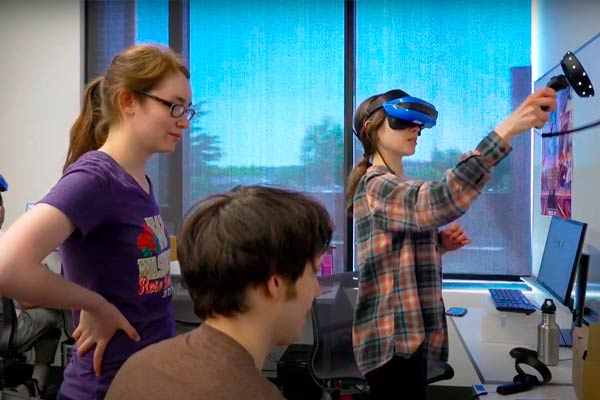
Capstones are senior-level project courses that allow you to solve a substantial problem with knowledge gained from many areas in computer science and engineering. Students work in teams to define a problem, develop a solution, produce and demonstrate an artifact that solves the problem, and present their work. Class time focuses on the project design and implementation, but it may also include lectures on the practical application of advanced topics. Interdisciplinary projects that require interaction with other departments are encouraged.
A Capstone course is not simply an advanced course in a particular sub-area, nor is it an unstructured project course. A Capstone is designed to be a culmination of your learning, and a chance to develop and express many skills at once: For example, technical expertise and communication ability.
Capstone Goals
- Efforts must culminate in an interesting, working artifact.
- Projects must be large enough to require teams of several students to work on over one quarter.
- Students must apply concepts from more than one sub-area of CSE (at the 300-level and above).
- The work must involve a substantial design effort.
- Students must present their work using formal oral presentations and written reports.
Capstone Course List
Autumn 2026
CSE 475: Embedded Systems Capstone
- Taught by: Shwetak N. Patel
- Prerequisites: Either EE 271 or CSE 369; either CSE 466, EE 472, or CSE 474/EE 474
- Description: Capstone design experience. Prototype a substantial project mixing hardware, software, and communications. Focuses on embedded processors, programmable logic devices, and emerging platforms for the development of digital systems. Provides a comprehensive experience in specification, design, and management of contemporary embedded systems.
- 5 Credits
CSE 482 A: Accessibility Capstone
- Taught by: Jennifer Mankoff
- Prerequisites: One of CSE 340, CSE 440, HCDE 302, INFO 360, or INFO 340.
CSE 332 and 351 not required, contact advising to register without the pre-requisite. - Description: Accessibility is quickly emerging as a leading consideration for product design and engineering. Disability is part of the human condition – almost everyone will be temporarily or permanently impaired at some point in life, and those who survive to old age will experience increasing difficulties. Disability is complex and heterogeneous, and the technological interventions to accommodate different abilities are wide ranging and vary with context. Many familiar technologies like voice recognition, text-to-speech, and gaze detection were initially engineered to assist people with disabilities gain more access and increase participation in daily life. Students will work in interdisciplinary project teams to apply design and engineering skills to create technology solutions that increase independence and improve quality of life for people of all abilities.
- 5 Credits
- Note: This course has a DIV designation and fulfills the diversity requirement
Winter 2027
TBA
Spring 2027
TBA
Autumn 2025
CSE 475: Embedded Systems Capstone
- Taught by: Shwetak N. Patel
- Prerequisites: Either EE 271 or CSE 369; either CSE 466, EE 472, or CSE 474/EE 474
- Description: Capstone design experience. Prototype a substantial project mixing hardware, software, and communications. Focuses on embedded processors, programmable logic devices, and emerging platforms for the development of digital systems. Provides a comprehensive experience in specification, design, and management of contemporary embedded systems.
- 5 Credits
CSE 481: Data Science Capstone
- Taught by: Tim Althoff
- Prerequisites: CSE 332 and CSE 312, and at least one of CSE 446, CSE 442, or CSE 344.
- Description: This Data Science Capstone focuses on the complete end-to-end process of data analysis performed with code: the iterative, and often exploratory, steps that analysts go through to turn data into results. Our focus is not limited to statistical modeling or machine learning, but rather the complete process, including transformation, exploration, modeling, and evaluation choices. Students will work in groups of four on a single project that will tie together and apply previous experiences from CSE 312, 332, 446, 442, 344, and other classes. Students are expected to already possess knowledge of appropriate machine learning, visualization and database methods, and will focus on independently applying those methods in the context of your project. There will therefore be limited lecture material in this course. Course staff will instead work closely with students to critique and advise on their group project. Students will experience the end-to-end data analysis process from transformation and exploration of data to modeling and evaluation. Your group will brainstorm on a project during the first week, before collaboratively exploring the data and implementing a complete data analysis workflow. This capstone course gives hands-on experience with selecting a data science question, and with crafting and evaluating a data science process to answer that question.
- Website
- 5 Credits
Winter 2026
- Taught by:Barbara Mones
- Prerequisites: CSE 458; CSE 459
- Description: Apply the knowledge gained in previous animation courses to produce a short animated film. Topics include scene planning, digital cinematography, creature and hard surface modeling, animatics and basics of character animation, and rendering techniques.
- Website
- 5 Credits
(*requires application and admission in summer)
- Taught by: ECE
- Prerequisites: Either EE 271 or CSE 369; either CSE 466, EE 472, or CSE 474/EE 474
- Description: Capstone design experience. Prototype a substantial project mixing hardware, software, and communications. Focuses on embedded processors, programmable logic devices, and emerging platforms for the development of digital systems. Provides a comprehensive experience in specification, design, and management of contemporary embedded systems.
- 5 Credits
- Taught by: Zoran Popovic
- Prerequisites: CSE 351, 332 and ideally one 400-level course
- Description: TBA
- 5 Credits
- Taught by: Ira Kemelmacher-Shlizerman
- Prerequisites: CSE 332, and at least one CSE 400 level course recommended
- Description: Virtual and Augmented reality are promising technologies that are certain to make an impact on the future of business and entertainment. In this capstone, students will work in small project teams to build applications and prototype systems using state of the art Virtual Reality (VR) and Augmented Reality (AR) technology. Seattle is a nexus of VR tech, with Oculus Research, Valve, Microsoft (hololens), Google (cardboard, jump), and teams in the area. We will be developing on the latest VR/AR headsets and platforms, and will bring in leading VR experts for lectures and to supervise student projects. Students will experience the end-to-end product cycle from design to deployment, and learn about VR/AR technology and applications. The capstone culminates in a highly anticipated demo day where the students demonstrate their creations to other students, faculty and industry luminaries. (See Video)
- Website
- 5 credits
- Taught by: James Fogarty
- Prerequisites: Either CSE 340, CSE 440, HCDE 318, or INFO 360
- Description: This capstone explores the design and development of interactive technologies that integrate language models in providing AI-based interactive capabilities. Students will explore creating human-AI interactions that address real-world needs and tasks, applying principles from human-centered design in support of those interactions. Course activities will emphasize student-led discussions of current challenges and approaches, a group project exploring vertical prototyping of human-AI interactions, and examination of and reflection on designing with and for this emerging space.
- 5 credits
- This capstone focuses on human-centered design with and around AI:
- We assume existing experience with human-centered design methods.
- We assume existing experience with or the ability to learn frameworks for developing interactive applications.
- We do not assume or expect existing experience developing with or around AI.
- We do not assume or expect engagement with development of the underlying AI.
Spring 2026
CSE 428: Computational Biology Capstone
- Taught by: Sheng Wang
- Prerequisites: CSE 312; CSE 331; CSE 332
- Description: Designs and implements a software tool or software analysis for an important problem in computational molecular biology.
- Website
- 5 Credits
CSE 475: Embedded Systems Capstone
- Taught by: ECE
- Prerequisites: Either EE 271 or CSE 369; either CSE 466, EE 472, or CSE 474/EE 474
- Description: Capstone design experience. Prototype a substantial project mixing hardware, software, and communications. Focuses on embedded processors, programmable logic devices, and emerging platforms for the development of digital systems. Provides a comprehensive experience in specification, design, and management of contemporary embedded systems.
- 5 Credits
- Taught by: Pang Wei Koh
- Prerequisites: CSE 446/546 and one of CSE 493 S (Advanced Machine Learning), CSE 493G (Deep Learning), CSE 447, CSE 455, CSE 478, or CSE 427.
- Description: Students will work in small groups (~3 people) to complete an independent machine learning research project in a domain of their choice (e.g., natural language processing; computer vision; medical data; machine learning theory; etc.). The focus will be on honing students’ research skills: formulating problems, picking up relevant technical knowledge, building research codebases, performing experiments and analysis, and writing up their results.
- 5 Credits
- Taught by: Basia Radka
- Prerequisites: CSE 484
- Description: Student teams will be tasked with creating a computer security themed product. The work will progress from product conception to requirements to design to implementation to evaluation. Along the way, students will incorporate key computer security tools and practices, including threat modeling, penetration testing, and bug fixing. Examples include password managers, censorship resistance systems, and mobile payment systems.
- Website
- 5 Credits
- Taught by: Maya Cakmak
- Prerequisites: Senior standing in CSE or permission of the instructor
- Description: The main goal of this course is to open up new career options in robotics for computer science and engineering students. To that end, the course will teach you the basics of robotics and give you implementation experience. You will learn to use libraries and tools within the most popular robot programming framework ROS (Robot Operating System). We will touch on robot motion, navigation, perception, planning, and interaction through mini-lectures, labs, and assignments, eventually integrating these components to create autonomous or semi-autonomous robotic functionalities. The project will give you team-work experience with large scale software integration and it will get you thinking about opportunities for using robots to address societal challenges.
- 5 Credits
- Taught by: Simon Peter
- Prerequisites: CSE 451
- Description: This course is intended to give students a thorough understanding of design and implementation issues for modern operating systems. We will cover key design issues in implementing an operating system, such as memory management, inter-core synchronization, scheduling, protection, inter-process communication, device drivers, and file systems, paying particular attention to system designs that differ from the traditional monolithic arrangements of Unix/Linux and Windows.
- Website
- 5 Credits
CSE 481: Networks and Mobile AI Capstone
- Taught by: Shyam Gollakota
- Prerequisites: Networks or ML course recommended but not required.
- Description: The “Networks and Mobile AI Capstone” course is designed to empower students to innovate at the intersection of mobile computing, wearables, on-device artificial intelligence, and networking. This course provides an opportunity to design and implement AI applications optimized for mobile devices, addressing challenges such as computational efficiency, real-time processing, and energy consumption. We will explore interesting applications like speech translation, mobile LLMs and multi-modal LLMs in the context of mobile and wearable devices and systems.
Students will also have opportunities to delve into networking technologies, exploring how connected systems and distributed AI can enable groundbreaking applications, from edge computing to real-time collaboration between devices. Students will learn to navigate the constraints of mobile hardware and deploy sophisticated machine learning models that enhance user experiences in dynamic, networked environments. By the end of the course, students will have not only gained technical skills in on-device AI and networking but also gained invaluable experience in project management, cross-disciplinary collaboration, and communicating technical solutions. This capstone prepares students for careers at the forefront of on-device AI and network-driven innovation, ready to redefine how intelligent systems connect and operate.
- 5 Credits
Autumn 2024
CSE 475: Embedded Systems Capstone
- Taught by: Shwetak N. Patel
- Prerequisites: Either EE 271 or CSE 369; either CSE 466, EE 472, or CSE 474/EE 474
- Description: Capstone design experience. Prototype a substantial project mixing hardware, software, and communications. Focuses on embedded processors, programmable logic devices, and emerging platforms for the development of digital systems. Provides a comprehensive experience in specification, design, and management of contemporary embedded systems.
- 5 Credits
CSE 481: Data Science Capstone
- Taught by: Tim Althoff
- Prerequisites: CSE 332 and CSE 312, and at least one of CSE 446, CSE 442, or CSE 344.
- Description: This Data Science Capstone focuses on the complete end-to-end process of data analysis performed with code: the iterative, and often exploratory, steps that analysts go through to turn data into results. Our focus is not limited to statistical modeling or machine learning, but rather the complete process, including transformation, exploration, modeling, and evaluation choices. Students will work in groups of four on a single project that will tie together and apply previous experiences from CSE 312, 332, 446, 442, 344, and other classes. Students are expected to already possess knowledge of appropriate machine learning, visualization and database methods, and will focus on independently applying those methods in the context of your project. There will therefore be limited lecture material in this course. Course staff will instead work closely with students to critique and advise on their group project. Students will experience the end-to-end data analysis process from transformation and exploration of data to modeling and evaluation. Your group will brainstorm on a project during the first week, before collaboratively exploring the data and implementing a complete data analysis workflow. This capstone course gives hands-on experience with selecting a data science question, and with crafting and evaluating a data science process to answer that question.
- Website
- 5 Credits
Winter 2025
CSE 460: Animation Capstone
- Taught by:Barbara Mones
- Prerequisites:CSE 458; CSE 459
- Description: Apply the knowledge gained in previous animation courses to produce a short animated film. Topics include scene planning, digital cinematography, creature and hard surface modeling, animatics and basics of character animation, and rendering techniques.
- Website
- 5 Credits
(*requires application and admission in summer)
CSE 475: Embedded Systems Capstone
- Taught by: ECE
- Prerequisites: Either EE 271 or CSE 369; either CSE 466, EE 472, or CSE 474/EE 474
- Description: Capstone design experience. Prototype a substantial project mixing hardware, software, and communications. Focuses on embedded processors, programmable logic devices, and emerging platforms for the development of digital systems. Provides a comprehensive experience in specification, design, and management of contemporary embedded systems.
- 5 Credits
- Taught by: ECE
- Prerequisites: Either EE 271 or CSE 369; either CSE 466, EE 472, or CSE 474/EE 474
- Description: Capstone design experience. Prototype a substantial project mixing hardware, software, and communications. Focuses on embedded processors, programmable logic devices, and emerging platforms for the development of digital systems. Provides a comprehensive experience in specification, design, and management of contemporary embedded systems.
- 5 Credits
CSE 481: Networks and Mobile AI Capstone
- Taught by: Shyam Gollakota
- Prerequisites: Networks or ML course recommended but not required.
- Description: The “Networks and Mobile AI Capstone” course is designed to empower students to innovate at the intersection of mobile computing, wearables, on-device artificial intelligence, and networking. This course provides an opportunity to design and implement AI applications optimized for mobile devices, addressing challenges such as computational efficiency, real-time processing, and energy consumption. We will explore interesting applications like speech translation, mobile LLMs and multi-modal LLMs in the context of mobile and wearable devices and systems.
Students will also have opportunities to delve into networking technologies, exploring how connected systems and distributed AI can enable groundbreaking applications, from edge computing to real-time collaboration between devices. Students will learn to navigate the constraints of mobile hardware and deploy sophisticated machine learning models that enhance user experiences in dynamic, networked environments. By the end of the course, students will have not only gained technical skills in on-device AI and networking but also gained invaluable experience in project management, cross-disciplinary collaboration, and communicating technical solutions. This capstone prepares students for careers at the forefront of on-device AI and network-driven innovation, ready to redefine how intelligent systems connect and operate.
- 5 Credits
CSE 482 A: Accessibility Capstone
- Taught by: Jennifer Mankoff
- Prerequisites: Either CSE 331 or CSE 340 AND either CSE 440 or CSE 493E: Accessibility. CSE 332 and 351 not required, contact advising to register without the pre-requisite.
- Description: Accessibility is quickly emerging as a leading consideration for product design and engineering. Disability is part of the human condition – almost everyone will be temporarily or permanently impaired at some point in life, and those who survive to old age will experience increasing difficulties. Disability is complex and heterogeneous, and the technological interventions to accommodate different abilities are wide ranging and vary with context. Many familiar technologies like voice recognition, text-to-speech, and gaze detection were initially engineered to assist people with disabilities gain more access and increase participation in daily life. Students will work in interdisciplinary project teams to apply design and engineering skills to create technology solutions that increase independence and improve quality of life for people of all abilities.
- 5 Credits
Note: This course has a DIV designation and fulfills the diversity requirement
Spring 2025
CSE 428: Computational Biology Capstone
- Taught by: Sheng Wang
- Prerequisites: CSE 312; CSE 331; CSE 332
- Description: Designs and implements a software tool or software analysis for an important problem in computational molecular biology.
- Website
- 5 Credits
CSE 475: Embedded Systems Capstone
- Taught by: ECE
- Prerequisites: Either EE 271 or CSE 369; either CSE 466, EE 472, or CSE 474/EE 474
- Description: Capstone design experience. Prototype a substantial project mixing hardware, software, and communications. Focuses on embedded processors, programmable logic devices, and emerging platforms for the development of digital systems. Provides a comprehensive experience in specification, design, and management of contemporary embedded systems.
- 5 Credits
- Taught by: Franzi Roesner
- Prerequisites: CSE 484
- Description: Student teams will be tasked with creating a computer security themed product. The work will progress from product conception to requirements to design to implementation to evaluation. Along the way, students will incorporate key computer security tools and practices, including threat modeling, penetration testing, and bug fixing. Examples include password managers, censorship resistance systems, and mobile payment systems.
- Website
- 5 Credits
CSE 481V Virtual and Augmented Reality Capstone
- Taught by: Ira Kemelmacher-Shlizerman
- Prerequisites: CSE 332, and at least one CSE 400 level course recommended
- Description: Virtual and Augmented reality are promising technologies that are certain to make an impact on the future of business and entertainment. In this capstone, students will work in small project teams to build applications and prototype systems using state of the art Virtual Reality (VR) and Augmented Reality (AR) technology. Seattle is a nexus of VR tech, with Oculus Research, Valve, Microsoft (hololens), Google (cardboard, jump), and teams in the area. We will be developing on the latest VR/AR headsets and platforms, and will bring in leading VR experts for lectures and to supervise student projects. Students will experience the end-to-end product cycle from design to deployment, and learn about VR/AR technology and applications. The capstone culminates in a highly anticipated demo day where the students demonstrate their creations to other students, faculty and industry luminaries. (See Video)
- Website
- 5 credits
- Taught by: Maya Cakmak
- Prerequisites: Senior standing in CSE or permission of the instructor
- Description: The main goal of this course is to open up new career options in robotics for computer science and engineering students. To that end, the course will teach you the basics of robotics and give you implementation experience. You will learn to use libraries and tools within the most popular robot programming framework ROS (Robot Operating System). We will touch on robot motion, navigation, perception, planning, and interaction through mini-lectures, labs, and assignments, eventually integrating these components to create autonomous or semi-autonomous robotic functionalities. The project will give you team-work experience with large scale software integration and it will get you thinking about opportunities for using robots to address societal challenges.
- 5 Credits
- Taught by: Alisa Liu and Orevaoghene Ahia
- Prerequisites: 446 or 447 strongly recommended but not required
- Description: This class will provide students with an intensive 10-week experience in successfully completing a challenging, well-scoped research project.
Participants will work in small groups (approximately 3 people in each group) to hone their technical skills to quickly absorb and adapt new technical knowledge, gain experience in complex programming, perform thorough experiments and analysis, and learn how to find a path when faced with negative results.
- 5 Credits
- Taught by: Simon Peter
- Prerequisites: CSE 451
- Description: This course is intended to give students a thorough understanding of design and implementation issues for modern operating systems. We will cover key design issues in implementing an operating system, such as memory management, inter-core synchronization, scheduling, protection, inter-process communication, device drivers, and file systems, paying particular attention to system designs that differ from the traditional monolithic arrangements of Unix/Linux and Windows.
- Website
- 5 Credits
CSE 481: Human-AI Interaction Capstone
- Taught by: James Fogarty
- Prerequisites: CSE 340 or CSE 440 or HCDE 318 or INFO 360
- Description: TBA
- 5 credits
- Taught by: Zoran Popovic
- Prerequisites: CSE 351, CSE 332, and ideally one 400-level CSE course
- Description: TBA
- 5 credits
Fall 2023
CSE 475: Embedded Systems Capstone
- Taught by: Shwetak N. Patel
- Prerequisites: Either EE 271 or CSE 369; either CSE 466, EE 472, or CSE 474/EE 474
- Description: Capstone design experience. Prototype a substantial project mixing hardware, software, and communications. Focuses on embedded processors, programmable logic devices, and emerging platforms for the development of digital systems. Provides a comprehensive experience in specification, design, and management of contemporary embedded systems.
- Website
- 5 Credits
CSE 481: Data Science Capstone
- Taught by: Tim Althoff
- Prerequisites: CSE 332 and CSE 312, and at least one of CSE 446, CSE 442, or CSE 344.
- Description: This Data Science Capstone focuses on the complete end-to-end process of data analysis performed with code: the iterative, and often exploratory, steps that analysts go through to turn data into results. Our focus is not limited to statistical modeling or machine learning, but rather the complete process, including transformation, exploration, modeling, and evaluation choices. Students will work in groups of four on a single project that will tie together and apply previous experiences from CSE 312, 332, 446, 442, 344, and other classes. Students are expected to already possess knowledge of appropriate machine learning, visualization and database methods, and will focus on independently applying those methods in the context of your project. There will therefore be limited lecture material in this course. Course staff will instead work closely with students to critique and advise on their group project. Students will experience the end-to-end data analysis process from transformation and exploration of data to modeling and evaluation. Your group will brainstorm on a project during the first week, before collaboratively exploring the data and implementing a complete data analysis workflow. This capstone course gives hands-on experience with selecting a data science question, and with crafting and evaluating a data science process to answer that question. question.
- Website
- 5 Credits
Winter 2024
CSE 460: Animation Capstone
- Taught by:Barbara Mones
- Prerequisites:CSE 458; CSE 459
- Description: Apply the knowledge gained in previous animation courses to produce a short animated film. Topics include scene planning, digital cinematography, creature and hard surface modeling, animatics and basics of character animation, and rendering techniques.
- Website
- 5 Credits
(*requires application and admission in summer)
CSE 475: Embedded Systems Capstone
- Taught by: ECE
- Prerequisites: Either EE 271 or CSE 369; either CSE 466, EE 472, or CSE 474/EE 474
- Description: Capstone design experience. Prototype a substantial project mixing hardware, software, and communications. Focuses on embedded processors, programmable logic devices, and emerging platforms for the development of digital systems. Provides a comprehensive experience in specification, design, and management of contemporary embedded systems.
- 5 Credits
- Taught by: Zoran Popovic
- Prerequisites: CSE 351, 332 and ideally one 400-level course
- Description: TBA
- 5 Credits
CSE 481 P: Social Computing Capstone
- Taught by: Amy Zhang
- Prerequisites: None, but CSE 440 is strongly suggested
- Description: In this capstone course, students will work in groups to apply software engineering and system design skills they have learned over their four years in computer science towards building a novel social computing system to address a social challenge. We will follow a human-centered design process for groups to ideate, prototype, test, implement, and showcase their novel system. Along the way, students will gain a broad understanding of the current major pressing issues and state of the art of knowledge in social computing, while taking a critical lens toward social computing systems they use every day. Along with the capstone project, we will have readings, group discussions, reflections, and guest speakers working in social computing.
- 5 Credits
- Taught by: Maya Cakmak
- Prerequisites: Senior standing in CSE or permission of the instructor
- Description: The main goal of this course is to open up new career options in robotics for computer science and engineering students. To that end, the course will teach you the basics of robotics and give you implementation experience. You will learn to use libraries and tools within the most popular robot programming framework ROS (Robot Operating System). We will touch on robot motion, navigation, perception, planning, and interaction through mini-lectures, labs, and assignments, eventually integrating these components to create autonomous or semi-autonomous robotic functionalities. The project will give you team-work experience with large scale software integration and it will get you thinking about opportunities for using robots to address societal challenges.
- 5 Credits
Spring 2024
CSE 428: Computational Biology Capstone
- Taught by: Sheng Wang
- Prerequisites: CSE 312; CSE 331; CSE 332
- Description: Designs and implements a software tool or software analysis for an important problem in computational molecular biology.
- Website
- 5 Credits
CSE 475: Embedded Systems Capstone
- Taught by: ECE
- Prerequisites: Either EE 271 or CSE 369; either CSE 466, EE 472, or CSE 474/EE 474
- Description: Capstone design experience. Prototype a substantial project mixing hardware, software, and communications. Focuses on embedded processors, programmable logic devices, and emerging platforms for the development of digital systems. Provides a comprehensive experience in specification, design, and management of contemporary embedded systems.
- 5 Credits
CSE 481V Virtual and Augmented Reality Capstone
- Taught by: Noah Smith
- Prerequisites: 446 or 447 strongly recommended but not required
- Description:This class will provide students with an intensive 10-week experience in successfully completing a challenging, well-scoped research project.
Participants will work in small groups (approximately 3 people in each group) to hone their technical skills to quickly absorb and adapt new technical knowledge, gain experience in complex programming, perform thorough experiments and analysis, and learn how to find a path when faced with negative results. - 5 Credits
-
CSE 481 A OS Capstone
- Taught by: Simon Peter
- Prerequisites: CSE 451
- Description:This course is intended to give students a thorough understanding of design and implementation issues for modern operating systems. We will cover key design issues in implementing an operating system, such as memory management, inter-core synchronization, scheduling, protection, inter-process communication, device drivers, and file systems, paying particular attention to system designs that differ from the traditional monolithic arrangements of Unix/Linux and Windows.
- Website
- 5 Credits
CSE 481 A: Neural Engineering Capstone
- Taught by: Rajesh Rao
- Prerequisites: Senior standing in CSE or permission of the instructor.
- Description: Design, build and present a prototype device or software tool that solves an important problem in neural engineering. Examples include interfaces based on combining AI with brain-, muscle-, and/or eye-tracking signals to control computers or robotic devices, virtual reality approaches to improving neural function, and machine learning-based software tools for analyzing large-scale neural data.
- 5 Credits
CSE 481: Game Design for Global Challenges
- Taught by: Steve Tanimoto
- Prerequisites: CSE 332 or instructor permission
- Description: Each team analyzes a wicked problem and develops a game that stimulates player engagement with the problem and approaches to solving it. Tools and techniques include Python, large language models, multiplayer supports, problem-solving theory from AI, formulation frameworks, simulation models, iterative design, Scrum-based agile development, and playtesting.
- 5 credits
CSE 482B: Capstone Software Design to Empower Underserved Populations
- Taught by: Richard Anderson
- Prerequisites: CSE 332; CSE 351; either CSE 331 or CSE 352
- Description: Students will work on a group project that makes use of Information and Communication Technologies (ICTs) to address global needs with an emphasis on developing countries. While ICTs are having an enormous impact on livelihoods worldwide, deployment environments vary dramatically based on available infrastructure and technologies accessible to people. Areas of projects could include: health information systems, data collection technologies, applications for basic mobile phones, user interface design for low literate populations, behavior change communication, voice based social networks, community cellular networks, open source projects for global good, low-cost smartphones, satellite image analysis or mobile financial services targeting domains including health, education, agriculture, finance, and livelihood.
- Website
- 5 credits (satisfies DIV requirement)
Fall 2022
-
CSE 475 Embedded Systems Capstone
- Taught by:Shwetak N. Patel
- Prerequisites: Either EE 271 or CSE 369; either CSE 466, EE 472, or CSE 474/EE 474
- Description: Capstone design experience. Prototype a substantial project mixing hardware, software, and communications. Focuses on embedded processors, programmable logic devices, and emerging platforms for the development of digital systems. Provides a comprehensive experience in specification, design, and management of contemporary embedded systems.
- Website
- 5 Credits
- Taught by:Tim Althoff
- Prerequisites: CSE 332 and CSE 312, and at least one of CSE 446, CSE 442, or CSE 344.
- Description: Data analysis is a central activity for scientific research and is increasingly a critical part of decision making in government and business. However, producing reliable data analysis outcomes is challenging since the decisions made throughout the analysis process can dramatically affect the eventual outcome. This Data Science Capstone focuses on the complete end-to-end process of data analysis performed with code: the iterative, and often exploratory, steps that analysts go through to turn data into results. Our focus is not limited to statistical modeling or machine learning, but rather the complete process, including transformation, exploration, modeling, and evaluation choices.
Students will work in groups of four on a single project that will tie together and apply previous experiences from CSE 312, 332, 446, 442, 344, and other classes. Students are expected to already possess knowledge of appropriate machine learning, visualization and database methods, and will focus on independently applying those methods in the context of your project. There will therefore be limited lecture material in this course. Course staff will instead work closely with students to critique and advise on their group project. Students will experience the end-to-end data analysis process from transformation and exploration of data to modeling and evaluation. Your group will brainstorm on a project during the first week, before collaboratively exploring the data and implementing a complete data analysis workflow. This capstone course gives hands-on experience with selecting a data science question, and with crafting and evaluating a data science process to answer that question. question.
- Website
- 5 Credits
Winter 2023
-
CSE 460: Animation Capstone
- Taught by:Barbara Mones
- Prerequisites:CSE 458; CSE 459
- Description: Apply the knowledge gained in previous animation courses to produce a short animated film. Topics include scene planning, digital cinematography, creature and hard surface modeling, animatics and basics of character animation, and rendering techniques.
- Website
- 5 Credits
(*requires application and admission in summer)
-
CSE 475 Embedded Systems Capstone
- Taught by: ECE Department
- Prerequisites: Either EE 271 or CSE 369; either CSE 466, EE 472, or CSE 474/EE 474
- Description: Capstone design experience. Prototype a substantial project mixing hardware, software, and communications. Focuses on embedded processors, programmable logic devices, and emerging platforms for the development of digital systems. Provides a comprehensive experience in specification, design, and management of contemporary embedded systems.
- Website
- 5 Credits
-
CSE 481 D Games Capstone
- Taught by: Haduong
- Prerequisites: CSE 351, 332 and ideally one 400
- Description: Coming soon…
- 5 Credits
-
CSE 481S Security Capstone
- Taught by: Roesner
- Prerequisites: CSE 312; CSE 331; CSE 332
- Description: Student teams will be tasked with creating a computer security themed product. The work will progress from product conception to requirements to design to implementation to evaluation. Along the way, students will incorporate key computer security tools and practices, including threat modeling, penetration testing, and bug fixing. Examples include password managers, censorship resistance systems, and mobile payment systems.
- Website
- 5 Credits
-
CSE 481V Virtual and Augmented Reality Capstone
- Taught by: Ira Kemelmacher-Shlizerman
- Prerequisites: CSE 332, and at least 1, CSE 400 level course recommended
- Description: Virtual and Augmented reality are promising technologies that are certain to make an impact on the future of business and entertainment. In this capstone, students will work in small project teams to build applications and prototype systems using state of the art Virtual Reality (VR) and Augmented Reality (AR) technology. Seattle is a nexus of VR tech, with Oculus Research, Valve, Microsoft (hololens), Google (cardboard, jump), and teams in the area. We will be developing on the latest VR/AR headsets and platforms, and will bring in leading VR experts for lectures and to supervise student projects. Students will experience the end-to-end product cycle from design to deployment, and learn about VR/AR technology and applications. The capstone culminates in a highly anticipated demo day where the students demonstrate their creations to other students, faculty and industry luminaries. (See Video)
- Website
- 5 Credits
Spring 2023
-
CSE 428A Computational Biology Capstone
- Taught by: Wang
- Prerequisites: CSE 312; CSE 331; CSE 332
- Description: Designs and implements a software tool or software analysis for an important problem in computational molecular biology.
- Website
- 5 Credits
-
CSE 475 Embedded Systems Capstone
- Taught by: ECE Department
- Prerequisites: Either EE 271 or CSE 369; either CSE 466, EE 472, or CSE 474/EE 474
- Description: Capstone design experience. Prototype a substantial project mixing hardware, software, and communications. Focuses on embedded processors, programmable logic devices, and emerging platforms for the development of digital systems. Provides a comprehensive experience in specification, design, and management of contemporary embedded systems.
- Website
- 5 Credits
-
CSE 481 Social Computing Capstone
- Taught by: Zhang
- Prerequisites: TBD
- Description: In this capstone course, students will work in groups to apply software engineering and system design skills they have learned over their four years in computer science towards building a novel social computing system to address a social challenge. We will follow a human-centered design process for groups to ideate, prototype, test, implement, and showcase their novel system. Along the way, students will gain a broad understanding of the current major pressing issues and state of the art of knowledge in social computing, while taking a critical lens toward social computing systems they use every day. Along with the capstone project, we will have readings, group discussions, reflections, and guest speakers working in social computing.
- Website
- 5 Credits
-
CSE 481C Capstone Software – Robotics
- Taught by: Cakmak
- Prerequisites: Senior standing in CSE or permission of the instructor
- Description: The main goal of this course is to open up new career options in robotics for computer science and engineering students. To that end, the course will teach you the basics of robotics and give you implementation experience. You will learn to use libraries and tools within the most popular robot programming framework ROS (Robot Operating System). We will touch on robot motion, navigation, perception, planning, and interaction through mini-lectures, labs, and assignments, eventually integrating these components to create autonomous or semi-autonomous robotic functionalities. The project will give you team-work experience with large scale software integration and it will get you thinking about opportunities for using robots to address societal challenges. At the end of the quarter students are expected to be able to:
- Explain basics of robot navigation, perception, planning, interaction;
- Enumerate challenging problems in robotics;
- Use important tools in ROS, contribute to ROS, find available packages in ROS;
- Operate a robot platform using ROS tools;
- Articulate the importance of interface design and robustness of functionalities in robotics.
- CSE 481N NLP Capstone
- Taught by: N. Smith
- Prerequisites: none listed
- Description:This class will provide students with an intensive 10-week experience in successfully completing a challenging, well-scoped research project.
Participants will work in small groups (approximately 3 people in each group) to hone their technical skills to quickly absorb and adapt new technical knowledge, gain experience in complex programming, perform thorough experiments and analysis, and learn how to find a path when faced with negative results. - 5 Credits
-
CSE 481 A OS Capstone
- Taught by: S. Peter
- Prerequisites: CSE 451
- Description:This course is intended to give students a thorough understanding of design and implementation issues for modern operating systems. We will cover key design issues in implementing an operating system, such as memory management, inter-core synchronization, scheduling, protection, inter-process communication, device drivers, and file systems, paying particular attention to system designs that differ from the traditional monolithic arrangements of Unix/Linux and Windows.
- Website
- 5 Credits
-
CSE 481 Networks & Mobile Systems Capstone
- Taught by: Shyam Gollakota
- Prerequisites: None
- Description: Create cool and interesting projects where you get to use various mobile systems and networking technologies. The capstone will include background material on Android programming, networking as well as how various sensors like GPS, IMU, acoustic work to enable tracking, localization, augmented reality and ranging applications.
This class will provide students with an intensive 10-week experience in successfully completing an intellectually-exciting project in mobile systems and networking. Participants will work in small groups to learn new technical skills to quickly absorb and adapt new technical knowledge, gain experience in mobile programming and networking, implement their ideas on mobile devices and perform thorough experiments and analysis. Other than programming, no prerequisites are required.
- Website
- 5 Credits
-
CSE 482K Technology for Resource Constrained Environments
- Taught by:R. Anderson
- Prerequisites: CSE 332; CSE 351; either CSE 331 or CSE 352
- Description: Students will work on group project that use of Information and Communication Technologies (ICTs) to address global needs with an emphasis on developing countries. While ICTs are having an enormous impact on livelihoods worldwide, deployment environments vary dramatically based on available infrastructure and technologies accessible to people. Areas of projects could include: health information systems, data collection technologies, applications for basic mobile phones, user interface design for low literate populations, behavior change communication, voice based social networks, community cellular networks, open source projects for global good, low-cost smartphones, satellite image analysis or mobile financial services targeting domains including health, education, agriculture, finance, and livelihood.
- 5 Credits
Fall 2021
-
CSE 475 Embedded Systems Capstone
- Taught by: Patel,Shwetak N.
- Prerequisites: Either EE 271 or CSE 369; either CSE 466, EE 472, or CSE 474/EE 474
- Description: Capstone design experience. Prototype a substantial project mixing hardware, software, and communications. Focuses on embedded processors, programmable logic devices, and emerging platforms for the development of digital systems. Provides a comprehensive experience in specification, design, and management of contemporary embedded systems.
- 5 Credits
- Taught by: Althoff
- Prerequisites: TBD
- Description: Student teams design and implement a software project involving multiple areas of the CSE curriculum. Course emphasizes the development process, rather than the product.
- 5 Credits
- Taught by: Heimerl
- Prerequisites: Recommended: HCI (440) or Operating Systems (451) or Networks (461)
- Description: Public Interest Technology Capstone Experience. Develop tools and technologies in partnership with communities around Seattle and Tacoma that assist in small organizations running Internet access networks. Focus on core network development as well as HCI and user-facing systems. Provides a comprehensive experience designing, building, and deploying technology in the real world with the goal of doing social good.
- Website
- 5 Credits
CSE 481 Capstone Software Design
CSE 481 Community Networking Capstone
Winter 2022
-
CSE 475 Embedded Systems Capstone
- Taught by: E.E.
- Prerequisites: Either EE 271 or CSE 369; either CSE 466, EE 472, or CSE 474/EE 474
- Description: Capstone design experience. Prototype a substantial project mixing hardware, software, and communications. Focuses on embedded processors, programmable logic devices, and emerging platforms for the development of digital systems. Provides a comprehensive experience in specification, design, and management of contemporary embedded systems.
- 5 Credits
- Taught by: Zhang
- Prerequisites: TBD
- Description: coming soon…
- 5 Credits
- Taught by: Ira Kemelmacher-Shlizerman
- Prerequisites: CSE 332, and at least 1, CSE 400 level course recommended
- Description: Virtual and Augmented reality are promising technologies that are certain to make an impact on the future of business and entertainment. In this capstone, students will work in small project teams to build applications and prototype systems using state of the art Virtual Reality (VR) and Augmented Reality (AR) technology. Seattle is a nexus of VR tech, with Oculus Research, Valve, Microsoft (hololens), Google (cardboard, jump), and teams in the area. We will be developing on the latest VR/AR headsets and platforms, and will bring in leading VR experts for lectures and to supervise student projects. Students will experience the end-to-end product cycle from design to deployment, and learn about VR/AR technology and applications. The capstone culminates in a highly anticipated demo day where the students demonstrate their creations to other students, faculty and industry luminaries. (See Video)
- Taught by: Anderson, Richard
- Prerequisites: CSE 351 and 332
- Description: Students will work on group project that use of Information and Communication Technologies (ICTs) to address global needs with an emphasis on developing countries. While ICTs are having an enormous impact on livelihoods worldwide, deployment environments vary dramatically based on available infrastructure and technologies accessible to people. Areas of projects could include: health information systems, data collection technologies, applications for basic mobile phones, user interface design for low literate populations, behavior change communication, voice based social networks, community cellular networks, open source projects for global good, low-cost smartphones, satellite image analysis or mobile financial services targeting domains including health, education, agriculture, finance, and livelihood.
- 5 Credits
CSE 481 Social Computing Capstone
CSE 481 V Virtual and Augmented Reality Capstone
CSE 482 K: Technology for Resource Constrained Environments – Richard Anderson
Spring 2022
-
CSE 428 A: Computational Biology Capstone
- Taught by: E.E.
- Prerequisites: CSE 312; CSE 331; CSE 332
- Description: Designs and implements a software tool or software analysis for an important problem in computational molecular biology.
- 5 Credits
- Taught by: E.E.
- Prerequisites: Either EE 271 or CSE 369; either CSE 466, EE 472, or CSE 474/EE 474
- Description: Capstone design experience. Prototype a substantial project mixing hardware, software, and communications. Focuses on embedded processors, programmable logic devices, and emerging platforms for the development of digital systems. Provides a comprehensive experience in specification, design, and management of contemporary embedded systems.
- 5 Credits
- Taught by: Kohno
- Prerequisites: CSE 312; CSE 331; CSE 332
- Description: Student teams will be tasked with creating a computer security themed product. The work will progress from product conception to requirements to design to implementation to evaluation. Along the way, students will incorporate key computer security tools and practices, including threat modeling, penetration testing, and bug fixing. Examples include password managers, censorship resistance systems, and mobile payment systems.
- 5 Credits
- Taught by: Popovic
- Prerequisites: CSE 351, 332 and ideally one 400
- Description: Coming soon…
- 5 Credits
- Taught by: Reinecke
- Prerequisites: none listed
- Description: Students will work in groups of three or four on a single project that parallels the experience of delivering an interactive prototype within a company or with a customer. Students are expected to already possess knowledge of appropriate HCI methods, and will focus on independently applying those methods in the context of your project. There will therefore be little lecture material in this course. Course staff will instead work closely with students to critique and advise on their group project. Students will experience the end-to-end product cycle from design to deployment.
- 5 Credits
- Taught by: Cakmak
- Prerequisites: Senior standing in CSE or permission of the instructor
- Description: This course contributes to the following ABET outcomes:
- (1) an ability to identify, formulate, and solve complex engineering problems by applying principles of engineering, science, and mathematics
- (2) an ability to apply engineering design to produce solutions that meet specified needs with consideration of public health, safety, and welfare, as well as global, cultural, social, , and economic factors
- (3) an ability to communicate effectively with a range of audiences
- (4) an ability to recognize ethical and professional responsibilities in engineering situations and make informed judgments, which must consider the impact of engineering solutions in global, economic, environmental, and societal contexts
- (5) an ability to function effectively on a team whose members together provide leadership, create a collaborative and inclusive environment, establish goals, plan tasks, and meet objectives
- (6) an ability to develop and conduct appropriate experimentation, analyze and interpret data, and use engineering judgment to draw conclusions
- (7) an ability to acquire and apply new knowledge as needed, using appropriate learning strategies
- 5 Credits
- Taught by: N. Smith
- Prerequisites: none listed
- Description:This course contributes to the following ABET outcomes:
- (1) an ability to identify, formulate, and solve complex engineering problems by applying principles of engineering, science, and mathematics
- (2) an ability to apply engineering design to produce solutions that meet specified needs with consideration of public health, safety, and welfare, as well as global, cultural, social, , and economic factors
- (3) an ability to communicate effectively with a range of audiences
- (4) an ability to recognize ethical and professional responsibilities in engineering situations and make informed judgments, which must consider the impact of engineering solutions in global, economic, environmental, and societal contexts
- (5) an ability to function effectively on a team whose members together provide leadership, create a collaborative and inclusive environment, establish goals, plan tasks, and meet objectives
- (6) an ability to develop and conduct appropriate experimentation, analyze and interpret data, and use engineering judgment to draw conclusions
- (7) an ability to acquire and apply new knowledge as needed, using appropriate learning strategies
- 5 Credits
- Taught by: Rajesh Rao
- Prerequisites: Senior standing in CSE or permission of the instructor.
- Description: Students work in substantial teams to design, implement, and release a software project involving multiple areas of the CSE curriculum. Emphasis is placed on the development process itself, rather than on the product. Teams are expected to develop a work plan, and to track and document their progress against it.
- 5 Credits
CSE 475 Embedded Systems Capstone
CSE 481 C: Capstone Software – Robotics
CSE 481 N: Capstone Software – NLP
CSE 481 A: Neural Engineering Capstone
Fall 2020
-
CSE/EE 475: Embedded Systems (Taught by CSE) – Bruce Hemingway
-
Prereq: CSE 369 and 474
-
Pre-req: CSE 332, 312 and one of (446, 442, 344)
-
Description: Data analysis is a central activity for scientific research and is increasingly a critical part of decision making in government and business. However, producing reliable data analysis outcomes is challenging since the decisions made throughout the analysis process can dramatically affect the eventual outcome. The Data Science Capstone focuses on the complete end-to-end process of data analysis performed with code: the iterative, and often exploratory, steps that analysts go through to turn data into results. Our focus is not limited to statistical modeling or machine learning, but rather the complete process, including transformation, exploration, modeling, and evaluation choices. Students will work in groups of three or four on a single project that will tie together and apply previous experiences from CSE 312, 332, 446, 442, 344, and other classes. Students are expected to already possess knowledge of appropriate machine learning, visualization and database methods, and will focus on independently applying those methods in the context of your project. There will therefore be little lecture material in this course. Course staff will instead work closely with students to critique and advise on their group project. Students will experience the end-to-end data analysis process from transformation and exploration of data to modeling and evaluation. Your group will brainstorm on a project during the first week, before collaboratively exploring the data and implementing a complete data analysis workflow. This capstone course gives hands-on experience with selecting a data science question, and with crafting and evaluating a data science process to answer that question. CSE students should have completed CSE 332 and CSE 312, and at least one of CSE 446, CSE 442, or CSE 344. There are no other requirements for participating in this capstone class.
Winter 2021
-
CSE 460: Animation Capstone – Barbara Mones (Note: requires application and admission in summer)
-
CSE/EE 475: Embedded Systems Capstone – ECE Faculty
-
Prereq: CSE 369 and 474
-
CSE 481i: Sound and Media Capstone – Bruce Hemingway
-
Pre-req: CSE 351, 332 and ideally one 400
-
Description: This capstone will build projects utilizing computer audio and video techniques for human interfacing, sound and video recording and playback, encoding and decoding, synchronization, sound synthesis, recognition, and analysis/resynthesis. Projects may contain any types of media. Students will work in teams to design, implement, and release a software project utilizing some of the techniques such as those in the links below.
-
We have two Oculus-VR development kits, two Tobii EyeX Eye-tracking Controllers, and 15 Leap Motion controllers for use in building musical/audio/media interfaces. We also have three Nvidia Jetson TX1 Developer Kits for high-performance Deep Neural Network learning and computer vision.
-
CSE 481 S: Security Capstone – Kohno
-
Prereq: CSE 484 (CE students graduating in fall who have not completed 484, please send email asap to ugrad-adviser@cs.washington.edu)
-
Description: Student teams will be tasked with creating a computer security themed product. The work will progress from product conception to requirements to design to implementation to evaluation. Along the way, students will incorporate key computer security tools and practices, including threat modeling, penetration testing, and bug fixing. Examples include password managers, censorship resistance systems, and mobile payment systems.
-
CSE 482: Accessibility Capstone – Anat Caspi
-
Prereq: (recommended) CSE 490 D, (recommended) CSE440
-
Notes: This course has a DIV designation and fulfills the diversity requirement
-
Description: Accessibility is quickly emerging as a leading consideration for product design and engineering. Disability is part of the human condition – almost everyone will be temporarily or permanently impaired at some point in life, and those who survive to old age will experience increasing difficulties. Disability is complex and heterogeneous, and the technological interventions to accommodate different abilities are wide ranging and vary with context. Many familiar technologies like voice recognition, text-to-speech, and gaze detection were initially engineered to assist people with disabilities gain more access and increase participation in daily life. Students will work in interdisciplinary project teams that include community members with expertise on project needs. Groups will follow participatory design practices and apply design and engineering skills to create technology solutions that increase independence and improve quality of life for people of all abilities. Teams will complete one end-to-end product iteration cycle: ideation, design, specification refinement, prototype and usability testing
Spring 2021
-
Description: Designs and implements a software tool or software analysis for an important problem in computational molecular biology.
-
Prerequisites: CSE 312; CSE 331; CSE 332
-
CSE/EE 475 A: Embedded Systems Capstone – ECE Faculty
-
Prereq: CSE 369 and 474
-
Description: Design, build and present a prototype device or software tool that solves an important problem in neural engineering. Examples include interfaces based on combining AI with brain-, muscle-, and/or eye-tracking signals to control computers or robotic devices, virtual reality approaches to improving neural function, and machine learning-based software tools for analyzing large-scale neural data.
-
Prerequisites: (Recommended) CSE 490N, (Recommended) CSE 446 or CSE 473
- Pre-req: CSE 351, 332 and ideally one 400
- Students will work in groups of three or four on a single project that parallels the experience of delivering an interactive prototype within a company or with a customer. Students are expected to already possess knowledge of appropriate HCI methods, and will focus on independently applying those methods in the context of your project. There will therefore be little lecture material in this course. Course staff will instead work closely with students to critique and advise on their group project. Students will experience the end-to-end product cycle from design to deployment.
- CSE 481 N: Natural Language Processing Capstone – Noah Smith
- Prereq: CSE 447, CSE446 (ML) is recommended
- Description: Algorithms that deal with text or speech, either as inputs as outputs, are increasingly part of our everyday lives. Systems that translate accurately between languages, read many documents and summarize or answer questions about them, and even hold conversations with us, are on the horizon. Successfully designing and implementing such systems requires understanding and integration of ideas from linguistics, statistics, and computation, and testing them rigorously requires a strong grasp of experimental methodology. This capstone course gives hands-on experience with selecting a natural language processing problem and with crafting and evaluating a solution.
-
CSE 481 V : Virtual and Augmented Reality – Ira Kemelmacher-Shlizerman
-
Prerequisites: CSE 332, and at least 1, CSE 400 level course recommended
-
Description: Virtual and Augmented reality are promising technologies that are certain to make an impact on the future of business and entertainment. In this capstone, students will work in small project teams to build applications and prototype systems using state of the art Virtual Reality (VR) and Augmented Reality (AR) technology. Seattle is a nexus of VR tech, with Oculus Research, Valve, Microsoft (hololens), Google (cardboard, jump), and teams in the area. We will be developing on the latest VR/AR headsets and platforms, and will bring in leading VR experts for lectures and to supervise student projects. Students will experience the end-to-end product cycle from design to deployment, and learn about VR/AR technology and applications. The capstone culminates in a highly anticipated demo day where the students demonstrate their creations to other students, faculty and industry luminaries. (See Video)
- CSE 482 K: Technology for Resource Constrained Environments – Richard Anderson
- Prereqs: CSE 351 and 332
- Description: Students will work on group project that use of Information and Communication Technologies (ICTs) to address global needs with an emphasis on developing countries. While ICTs are having an enormous impact on livelihoods worldwide, deployment environments vary dramatically based on available infrastructure and technologies accessible to people. Areas of projects could include: health information systems, data collection technologies, applications for basic mobile phones, user interface design for low literate populations, behavior change communication, voice based social networks, community cellular networks, open source projects for global good, low-cost smartphones, satellite image analysis or mobile financial services targeting domains including health, education, agriculture, finance, and livelihood.