Our researchers are driving innovation across the entire hardware, software and network stack to make computer systems more reliable, efficient and secure.
From internet-scale networks, to next-generation chip designs, to deep learning frameworks and more, we build and refine the devices and applications that individuals, industries and, indeed, entire economies depend upon every day.
Research Groups & Labs
Information and Communication Technology for Development (ICTD) Lab
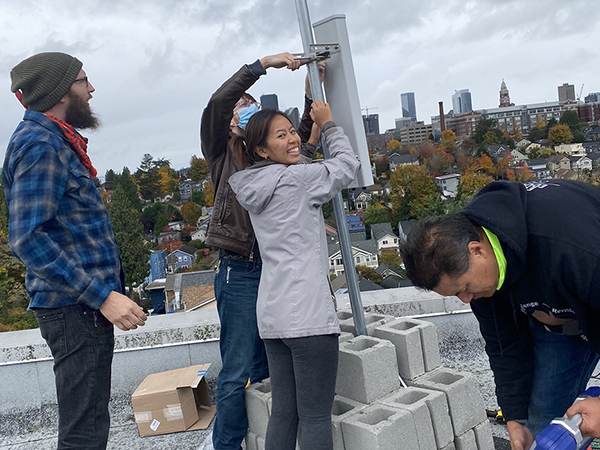
The ICTD Lab explores how technology can improve the lives of underserved populations in low-income regions through research spanning HCI, systems, communication and data analytics.
The UW Database Group does theoretical, systems and user-centered work in multimodal database management systems; generative AI and data management; complexity of query evaluation and optimization; scalable, interactive data visualization; and more.
The eScience Institute empowers researchers and students in all fields to answer fundamental questions through the use of large, complex, and noisy data. As the hub of data-intensive discovery on campus, we lead a community of innovators in the techniques, technologies, and best practices of data science and the fields that depend on them.
MEM-C is a NSF Materials Research Science and Engineering Center that integrates materials innovations with theory and computation to advance spin-photonic nanostructures and elastic layered quantum materials, aided by an “AI Core” that integrates artificial intelligence-driven materials discovery.
Allen School Ph.D. student Yael Eiger and professor Franziska Roesner discuss their research examining people’s experiences with technology during and after incarceration and the broader impacts of technology used for policing and post-release monitoring.
In their 2017 paper, Roesner and her co-authors were among the first to investigate end-user security and privacy perspectives on then-emerging smart home technologies and recommend ways to help users make more informed security decisions.
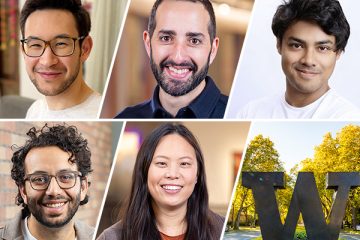
Professors Andrea Coladangelo, Matthew Golub, Ranjay Krishna, Chinmay Nirkhe, and Stephanie Wang are shaping the future of computing through projects spanning AI, systems, computational neuroscience, cryptography and quantum computing.