
University of Washington student group AVELA – A Vision for Engineering Literacy & Access is making STEM education more accessible to more students. The organization provides free courses and workshops for kindergarten to high school students in topics such as artificial intelligence, virtual reality and robotics, while pairing learners with college, graduate and professional mentors.
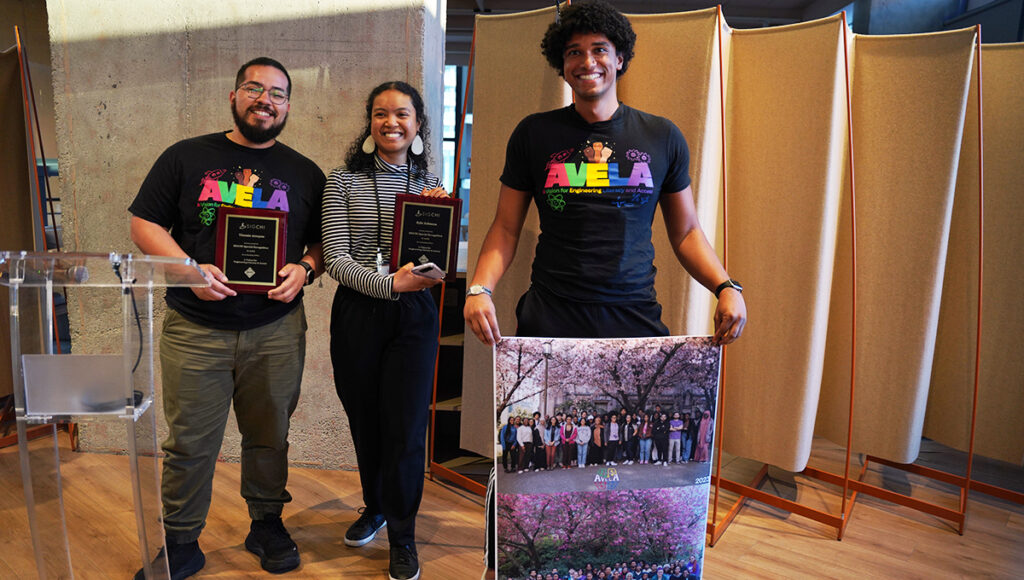
At the ACM CHI Conference on Human Factors in Computing Systems (CHI 2026) in April, AVELA co-founders and Allen School Ph.D students Vicente Arroyos and Kyle Johnson received a SIGCHI Special Recognition “for building an impactful mentorship ecosystem that empowers thousands of underrepresented youth and strengthens community-rooted STEM learning and workforce development.”
We recently spoke with Arroyos and Johnson to learn more about AVELA and their work.
What is AVELA?
Vicente Arroyos: AVELA started out here at the University of Washington as a student organization in 2019, and grew into a 501(c)3 nonprofit in 2022, but our mission is still the same. We are a STEM outreach organization that uses mentorship to provide STEM experiences to youth, whether that be in industry or in research fields.
Kyle Johnson: AVELA’s model is built around multi-tiered near-peer mentorship. Graduate students mentor undergraduates early in their academic and professional journeys, helping them build technical skills through hands-on, research and community-driven projects. Those undergraduates then translate what they’re learning into engaging lesson plans, workshops and resources that bring emerging areas of computing and engineering to elementary, middle and high school students. Our programs are designed to reach youth who are furthest from educational equity, so we work a lot with students who are first generation, low income as well as those from historically marginalized backgrounds.
Using their talent, energy and leadership, AVELA students are creating measurable changes across the state.
How many students has AVELA worked with?
VA: Since we founded the organization in 2019, AVELA has supported over 500 college instructors in mentoring more than 7,000 K–12 students, delivering more than 125,000 hours of STEM instruction. Between 2024 to 2025 alone, we supported 150 unique college instructors across 77 classrooms in leading 30,419 hours of learning to 2,101 secondary students. This impact would not be possible without our student members. Using their talent, energy and leadership, AVELA students are creating measurable changes across the state.
KJ: I want to highlight the 125,000 hours of STEM instruction, because it shows the depth of AVELA’s engagement with students. When you divide those hours across more than 7,000 students, it comes out to nearly 18 hours of mentorship per student. That is enough time not only to teach technical skills, but to build trust, talk about college and career pathways and support students beyond the project itself. I often say that 50% of the work is STEM education, and the other 50% is life and career mentorship.
How does AVELA choose what kinds of topics to teach to students?
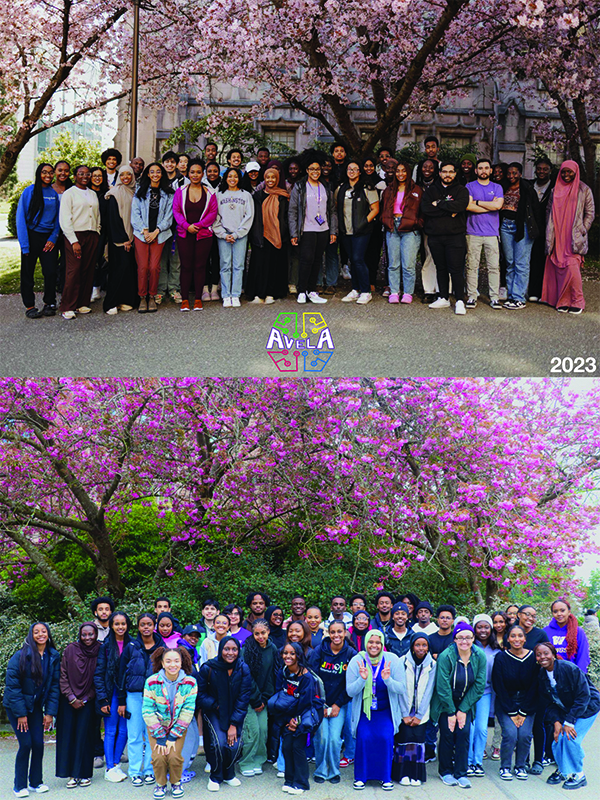
VA: Personally, I had few chances to explore the topics I was interested in as a secondary student, and it was a handful of early opportunities that gave me my first real exposure and sparked that flame. That’s why our priority is letting the students guide the topics.
Today, we’ve expanded well beyond the content we started with. We began with engineering, since that was the interest of our founding group, but as students came through we grew into health-related fields and beyond because the interest was there, from both the K–12 students and the undergrads at the time.
KJ: AVELA’s programming has always evolved with student interests. Most of our projects start when students come to us excited about an emerging technology. That was true with chatbots and AI: before ChatGPT was released in 2022, students were already asking how these systems worked. So in 2021 and 2022, we were building lessons around AI and machine learning because that was what students wanted to learn.
Now, students are excited to work on projects related to microrobotics, quantum computing and extended reality, but they are not stopping at the technology itself. They are going back into their communities, identifying real problems and asking how these tools can be used to solve them.
What is next for AVELA?
VA: There’s been a start in getting mentors going across the nation, but currently we’re still mainly in the greater Seattle area. It’d be great to see the organization and what has been built here be replicated in other cities.
KJ: We don’t have a shortage of undergraduates who want to do this work, nor a shortage of community partners who want them in their classrooms. The challenge has always been building enough buy-in from faculty and professional mentors to support them. Greater mentorship involvement, especially through grants that fund undergraduate roles, would allow AVELA to reach more students with higher quality, and more frequent, lessons. There are many bright students ready to contribute, but expanding access means providing these students meaningful, paid opportunities to grow.
Students are excited to work on projects related to microrobotics, quantum computing and extended reality, but they are not stopping at the technology itself. They are going back into their communities, identifying real problems and asking how these tools can be used to solve them.
In addition to Arroyos and Johnson, fellow AVELA co-founder Liban Hussein, who graduated from the UW Department of Electrical & Computer Engineering and is now at Boeing, also received a SIGCHI Special Recognition.
Learn more about the 2026 SIGCHI Awards here, and more about AVELA’s work here.