
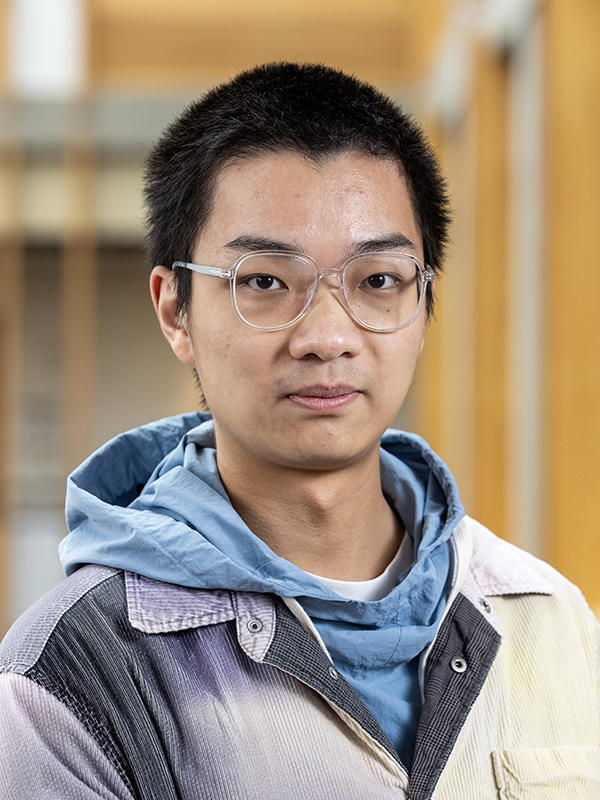
Allen School Ph.D. student Shangbin Feng aims to build a more open and democratic artificial intelligence future. To that end, his research focuses on model collaboration, where “multiple AI models, trained on different data, by different people, and thus possess diverse skills and strengths, collaborate, compose and complement each other.”
In December, Feng was named among the 2026 class of NVIDIA Graduate Fellows in recognition of his work. The NVIDIA Graduate Fellowship program supports graduate students from around the world whose outstanding research puts them at the forefront of accelerated computing and is relevant to the company’s interests.
“Through model collaboration, I aim to spearhead a modular, compositional, decentralized, and participatory AI future — that everyone everywhere could have a say in the future of AI by contributing data, models, or natural language feedback reflecting their interests and priorities, and building a compositional AI system from the bottom up with their decentralized contributions,” said Feng, who is advised by Allen School professor Yulia Tsvetkov.
Feng used model collaboration techniques to enhance the reliability and trustworthiness of large language models (LLMs). Despite evolving efforts to expand the LLMs’ knowledge base, they still run into knowledge gaps, or missing or outdated information. To help models abstain from generating low-confidence outputs, he and his team introduced two novel, robust multi-LLM collaboration-based approaches where LLMs probe other LLMs for knowledge gaps, either cooperatively or competitively. When multiple LLMs are working together in cooperation, one LLM employs other models to give feedback on the proposed answer, and it then synthesizes all the outputs into an overall abstain decision. In a competitive setting, the LLM is challenged by other models with conflicting information, and it has to decide whether to abstain or not. The team’s paper describing this approach received an Outstanding Paper Award at ACL 2024, the conference organized by the Association for Computational Linguistics.
I aim to spearhead a modular, compositional, decentralized, and participatory AI future — that everyone everywhere could have a say in the future of AI.
In the same vein of competitive LLM collaboration, Feng helped introduce Sparta Alignment, a framework that collectively aligns multiple language models through combat and game theory. Models form a “sparta tribe” to battle against, evaluate and learn from the strengths and weaknesses of each other. In each iteration, a pair of models duel by generating responses to sampled prompts from the dataset, while the remaining models judge their outputs. As models win or lose battles their reputation shifts, impacting how much say they have in evaluating other LLMs. For Feng, Sparta Alignment “enables the collaborative evolution of diverse LLMs without external supervision.”
He has also utilized multi-LLM collaboration to help pluralistically align models to better reflect the diversity of human values, intentions and preferences. Additionally, Feng developed the collaborative search algorithm called Model Swarms, in which diverse LLM experts collectively move in the parameter search space using swarm intelligence.
“Shangbin works on ‘model collaboration,’ a research program he is pioneering,” said Tsvetkov. “Advancing this program, Shangbin has already achieved a highly prolific publication record with peer-reviewed papers (mostly first-author) in top conferences.”
That record includes the aforementioned Outstanding Paper Award at ACL 2024, the top conference in natural language processing; a Best Paper Award at ACL 2023; a spotlight paper at the 37th Annual Conference on Neural Information Processing Systems (NeurIPS 2023), the top machine learning conference; an oral presentation at the 12th International Conference on Learning Representations (ICLR 2024), representing the top 1.2% of accepted papers; and an Area Chair Award in the QA Track at ACL 2024 (one of the most competitive track in NLP conferences).
In addition to receiving a 2026 NVIDIA Graduate Fellowship, Feng has also been recognized with an 2024 IBM Ph.D. fellowship and a 2025 Jane Street Graduate Research fellowship.
Read more about the NVIDIA Graduate Fellowship here.