
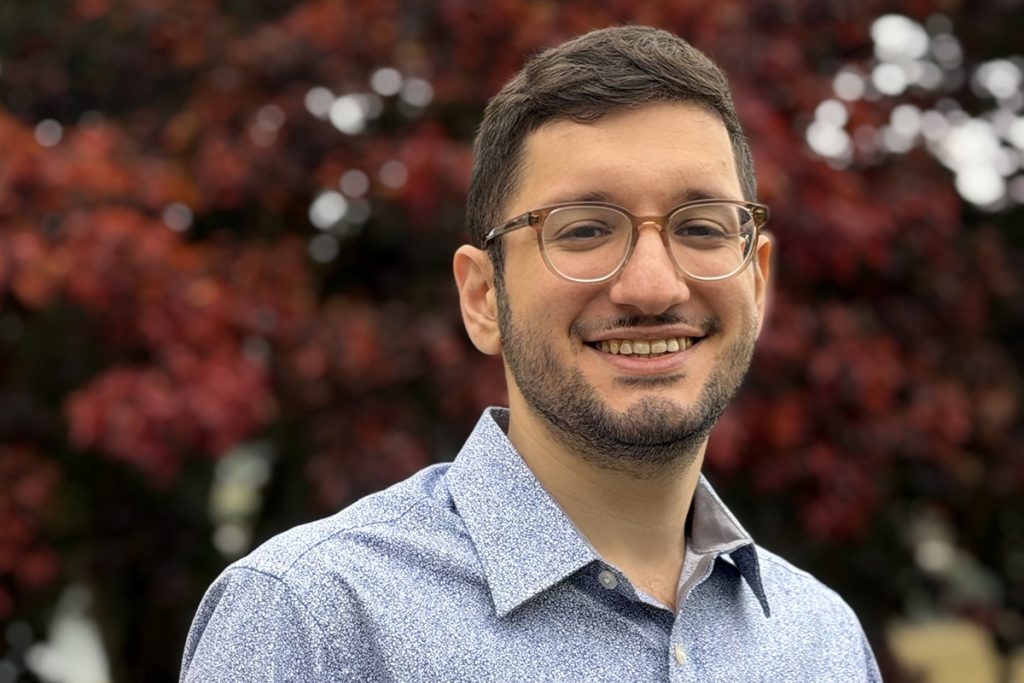
In 2022, University of Washington Ph.D. student Malek Itani purchased his first pair of Apple Airpods Pro in a pre-holiday sale. When he put them in his ears, something clicked — and it wasn’t a sound, but rather an idea.
“I put them on my ears, and I turned on noise canceling, and suddenly I felt like I was in my own personal space,” said Itani, a research assistant in the Mobile Intelligence Lab led by Allen School professor Shyam Gollakota. “I thought, ‘Wow, we can do something here.’
“But the model I was working on at the time was kind of huge, and not real-time, and definitely not something you can put on earbuds,” he continued. “And Shyam said, ‘But what if you can?’ “
Itani, a student in the UW Department of Electrical & Computer Engineering, embraced the challenge. And after four years of steady and, at times, astounding progress, he received a Marconi Society Paul Baran Young Scholar Award for exceptional early-career research that is advancing the future of information and communications technology (ICT). Itani is one of only three scholars selected from a record-high number of nominees from around the world; he and his fellow honorees will be formally recognized at the Marconi Awards Gala & Institute Forums November 4-6 in San Francisco, California.
“Malek has been a key part of every major contribution to the field of superhuman hearing in recent years,” said Gollakota. “He entered his Ph.D. with a background in RF and backscatter, but he rapidly mastered audio signal processing and deep learning, which is very impressive.”
As an undergraduate, Itani was eager to explore different areas of his chosen field. He dabbled in the aforementioned radiofrequency (RF) communication, embedded systems, robotics and even competitive programming — all the while resisting well-meaning suggestions that he specialize. That breadth of experience was an asset in Gollakota’s lab, where the research is cross-disciplinary and the members approach problems from different, sometimes unexpected, angles.
Itani embodied this ethos during his first foray into the soundscape, which focused not on in-ear capabilities but around-the-room. In his first paper as a primary author, Itani and co-primary author Tuochao Chen, a Ph.D. student in the Allen School, introduced acoustic swarms, a system that creates speech zones in a room by tracking and separating multiple speakers simultaneously. The system consists of a neural network paired with a set of small robotic microphones that self-distribute across a space using only sound — no cameras or special substrate required. The robots automatically return to their charging station after deployment, making the system portable and easy to set up in new locations.
As it turned out, the project was Itani’s ideal introduction to his new line of research.
“The transition from RF to audio is actually simple, because you work with waves and frequencies — but instead of looking at gigahertz, you’re now looking at kilohertz,” Itani explained, “In some sense, it’s easier working with sound, because there’s less data to process. And it’s also more fun to work with, because you get to hear the end product.”
It was when he teamed up with another labmate, Bandhav Veluri (Ph.D., ‘25), on a project called Waveformer that he began to embrace this new direction.
“I had a lot of background in embedded systems because of my undergraduate work and because of the robots,” Itani said. “I was able to take that and port it over to an embedded system, run it in real time, and integrate it with the noise-cancelling headsets. That’s where I started to really learn about real-time audio processing.”
I feel like I’ve hit a niche that’s going to be so transformational, and it’s going to be in billions of devices. It’s going to change the way we hear the world.
The result was the first neural network capable of real-time, streaming target sound extraction, which the researchers then translated into semantic hearing. Using off-the-shelf headphones paired with a smartphone, Itani and Veluri created a system that enabled the wearer to tailor what sounds they hear in their environment. For example, a person could program the device so that they could hear bird song while walking in the park but not the sound of nearby traffic. A subsequent project, target speech hearing, enabled wearers to focus on the voice of a single companion in a crowd simply by looking at them. The system leverages AI to learn and latch onto the target person’s speech patterns, which it plays back to the wearer in real time while canceling out other voices.
Itani and Chen then extended the wearer’s control over their soundscape from selected sounds to a selected space with a prototype headset that enabled the wearer to create a sound bubble. All sounds within the bubble’s perimeter are heard clearly; sounds outside the bubble are muffled or silenced. An onboard neural network determines which sounds to amplify or suppress based on the distance of each source from the embedded microphones.
That successful proof of concept inspired Itani to aim smaller and refine the technology for earbuds and hearing aids.
“Hearing aids are a natural use case,” Itani said. “In a noisy environment, hearing aids will amplify everything, but if you use AI you can amplify specific sounds that people care about. And you can recover not only what they would have heard, but you can also recover things that humans normally can’t hear. That’s where the concept of superhuman hearing comes from — you’re extending what’s possible with normal hearing.”
But this use case required the team to incorporate AI into devices with significant power and processing constraints. Last year, Itani, Chen and Gollakota partially answered that question with the development of TF-MLPNet, the first real-time neural speech separation network capable of running on low-power hearables like earbuds and hearing aids. They achieved another first with the introduction of NeuralAids, a programmable on-device AI platform for wireless hearables that achieves real-time speech enhancement under strict power constraints.
It wasn’t long before the team’s progress attracted the attention of industry. The team co-founded a UW startup, Hearvana AI, which raised $6 million last fall to support their push to bring acoustic intelligence to market.
As for what happens next, Itani says to stay tuned.
“I feel like I’ve hit a niche that’s going to be so transformational, and it’s going to be in billions of devices. It’s going to change the way we hear the world,” Itani said. ”Because of how important this is going to be, and how much this is going to change people’s lives, it genuinely feels like I have this responsibility to push this forward. I get to impact many, many people with this.”
To learn more, read the Marconi Society announcement and Itani’s Young Scholar profile, and visit Itani’s personal website.