
Alumni News
The Allen School’s Alumni News features stories and updates that celebrate the achievements and experiences of our alumni.
-
February 27, 2026 -
Allen School News
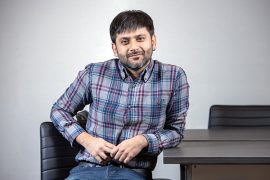
The Association for Computing Machinery (ACM) recognized Mahajan (Ph.D., ‘05) among its 2025 class of ACM Fellows for his groundbreaking “contributions to network verification and network control systems and their transfer to industrial practice.”
-
February 25, 2026 -
GeekWire
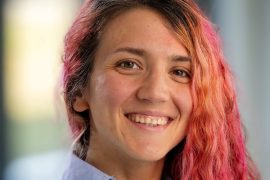
Allen School alum Kiana Ehsani (Ph.D., ‘21) co-founded Vercept to advance AI for automating repetitive computer tasks. The company spun out of the Ai2 Incubator and raised $50 million in seed funding before its acquisition by Anthropic, developer of the Claude AI assistant.
-
February 17, 2026 -
UW News
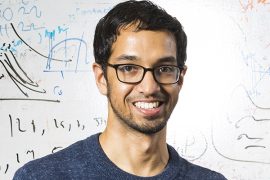
Iyer, co-director of the interdisciplinary CS for the Environment Initiative, was recognized among the 2026 class of fellows for his early-career efforts to address sustainability challenges — from recyclable electronics, to battery-free robotics, to AI-optimized hardware design.
-
February 4, 2026 -
UW News
In a paper published in the journal Nature, a team of Allen School and Ai2 researchers unveiled OpenScholar, a system that can cite scientific papers as accurately as human experts and incorporate new research after it has been trained.

-
December 9, 2025 -
GeekWire
A team co-led by Allen School professor Sheng Wang and Ph.D. alum Hoifung Poon unveiled GigaTIME, a multimodal model for generating detailed data on cancer progression and immune response from standard pathology slides — at a fraction of the time and cost of prior methods.
-
December 4, 2025 -
Allen School News
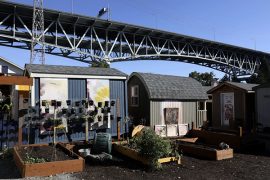
In a Q&A, professor Kurtis Heimerl and postdoc Esther Han Beol Jang (Ph.D., ‘24) discuss their work with residents of two Seattle tiny house villages on how they can leverage smart technologies to improve living conditions, balanced against concerns such as cost and continuity of deployment.
-
December 2, 2025 -
GeekWire
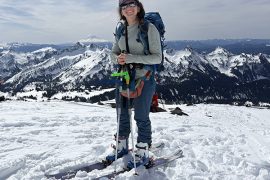
Ehsani (Ph.D., ‘21) is the “brilliant, dedicated and intuitive” co-founder and CEO of Vercept, which has developed an AI tool called Vy that automates repetitive tasks to enable humans to focus on more creative pursuits.
-
October 29, 2025 -
Allen School News
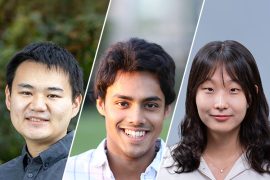
Professors Simon Shaolei Du and Ranjay Krishna, and Sewon Min (Ph.D., ‘24), now faculty at University of California, Berkeley and a research scientist at Ai2, were honored by MIT Technology Review for their work in AI, large language models, computer vision and more.
-
October 8, 2025 -
Allen School News
Mahajan (Ph.D., ‘05) was recognized for his work on Batfish, an open source network configuration analysis tool that helps find errors and prevent costly outages that could disrupt air travel, banking, communications and more.
-
October 2, 2025 -
Allen School News
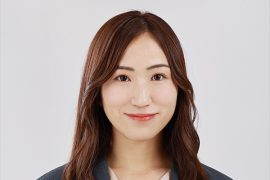
Asai (Ph.D., ‘25), research scientist at Ai2 and incoming faculty at Carnegie Mellon University, was recognized for her pioneering research that has helped establish the foundations for retrieval-augmented generation (RAG) and showcase its effectiveness at reducing LLM hallucinations.