

After more than four decades on the faculty, Henry M. Levy (Hank) officially retired from the University of Washington last summer. Now Professor and Wissner-Slivka Chair Emeritus in Computer Science & Engineering, Levy has the distinction of having been the longest-serving leader in the Allen School’s history, with 14 years at the helm.
It’s just one of many he has accrued during his time at the UW. Levy’s list of credits as department chair and, later, the Allen School’s founding director includes several more memorable milestones: the 50th anniversary of Computer Science & Engineering at the UW, when it was elevated from a department to a school; the grand opening of a second building, the Bill & Melinda Gates Center, to complement the program’s first permanent home, the Paul G. Allen Center; and a doubling of both faculty size and annual degree production.
Along the way, Levy was a driving force behind the UW’s emergence as a powerhouse of computing research.
“I always felt that UW could be one of the very top schools in computer science, and that was my goal. The way to achieve that is by attracting the best people,” Levy said. “And the way you do that is by creating a warm, welcoming and collaborative environment that people enjoy being a part of.”
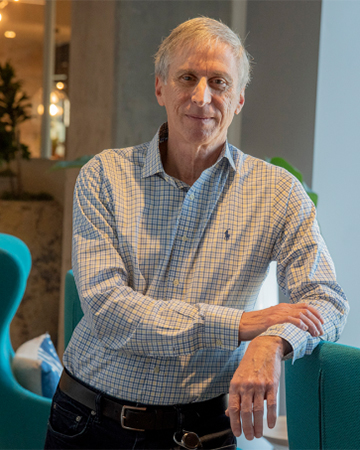
That warmth is not an act; Levy genuinely cares about the people he works with. Some of those same people are now paying him back by paying it forward. To honor Levy’s legacy at the Allen School, friends and colleagues are contributing to the creation of a professorship that will enhance the UW’s ability to attract, retain and develop faculty with the potential to make significant professional and scholarly contributions in Computer Science & Engineering.
According to one such friend and colleague, former Microsoft Corporate Vice President Rob Short (M.S., ‘86), “Hank has made significant, widely used contributions to the fields of distributed systems and CPU design, but I feel that his leadership of UW Computer Science & Engineering has had a much broader impact.”
Levy never aspired to an academic career. He joined Digital Equipment Corporation — affectionately known as DEC (pronounced like “deck”) — straight out of Carnegie Mellon University after earning his bachelor’s in mathematics and computer science in the mid-1970s. At DEC, he worked on commercial operating systems and systems architecture, which led him to write a book on VAX computer design that quickly became a standard for introductory courses in computer architecture — including at the UW. In 1978, Levy met then-professor Ed Lazowska at a DEC User’s Group meeting. The two became friends, and Lazowska later convinced Levy to spend a year at the UW. Once there, he earned his master’s degree, wrote his second book, “Capability-Based Computer Systems,” and formed a partnership with Lazowska that would shape the future of the Allen School.
Levy subsequently went back to the East Coast, but he missed the UW and Seattle. He returned two years later when the UW offered him a two-year research faculty position. “What was meant to be a two-year visit turned into 40,” Levy said.
Upon returning to the UW, Levy sparked a remarkable streak of four consecutive Best Paper Awards at the biennial ACM Symposium on Operating Systems Principles (SOSP) between 1985 and 1991. The first, co-authored with former DEC colleagues Nancy Kronenberg and Bill Strecker, introduced the VAXcluster system — a milestone in clustered computing through co-designed hardware and software that was decades ahead of its time. Subsequent papers with UW faculty and students pioneered new mechanisms in distributed and parallel systems: Emerald, an early programming language supporting distributed and mobile objects, co-authored with Andrew Black, Norm Hutchinson (Ph.D., ‘87) and Eric Jul (Ph.D., ’89); and two papers co-authored with Lazowska, Brian Bershad (Ph.D., ‘90) and Tom Anderson (Ph.D., ‘91) introducing Lightweight Remote Procedure Call and Scheduler Activations.
I always felt that UW could be one of the very top schools in computer science, and that was my goal. The way to achieve that is by attracting the best people.
These projects put the UW on the map as one of the leading systems research groups in the nation. Its position was further solidified when Levy and his faculty colleague Susan Eggers teamed up with students Dean Tullsen (Ph.D., ‘96) and Jack Lo (Ph.D., ‘98) to invent simultaneous multithreading (SMT), a hardware technique for increasing instruction parallelism to boost processor throughput. The first commercially viable multithreaded architecture, SMT was adopted by industry heavyweights including Intel, IBM and Sun.
Well over a decade later, in 2010 and 2011, Levy, Eggers and their collaborators were recognized by the IEEE Computer Society and ACM Special Interest Group on Computer Architecture with back-to-back Influential Paper Awards: the first for introducing the SMT technique, and the second, written jointly with Joel Emer and Rebecca Stamm at DEC, for describing a practical hardware implementation. This string of successes — just a fraction of Levy’s record of nearly 20 paper awards during his career — established him as “a true icon” in the field, according to Amin Vahdat, chief technologist and senior vice president of AI and infrastructure at Google.
“Hank has fundamentally shaped the systems research community. His pioneering work laid the core technical groundwork for the design of modern operating systems and large-scale computing platforms,” said Vahdat, who got to know Levy as a visiting researcher at the UW and recently recruited him to help set up a new research group at the company. “Hank is an enduring giant whose intellectual contributions are woven into the fabric of computer systems, and his legacy is carried forward by generations of students, myself included, who learned from him not just what to do, but how to do it.”
In 2011, Levy was elected to the National Academy of Engineering “for contributions to design, implementation, and evaluation of operating systems, distributed systems, and processor architectures.” And he did it all without having a Ph.D. — a point of personal pride as well as a running joke between him and his faculty colleagues. The joke even found its way into the faculty skit, an annual holiday tradition that Levy started in which he dressed faculty in silly costumes and wrote self-deprecating lines for them to “show grad students that faculty were human.” Including himself, of course.
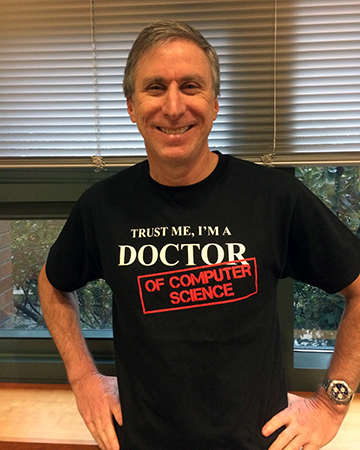
“One year, I created my own character called Dr. CSE who would appear in a white lab coat, make fun of himself and everyone there, and flaunt the superiority of a master’s in computer science and engineering over higher degrees,” Levy said with a laugh.
Levy may enjoy flouting academic convention, but he derives the greatest satisfaction from the culture he built within the school — something that those who have the good fortune to work with him are quick to emphasize.
“Beyond the string of best paper awards and his multi-decade impact on industry, what truly sets Hank apart is his unique ability to architect warm, inviting and meticulously crafted cultures,” Vahdat said. “When I decided to start a new systems research group at Google, choosing Hank to co-lead it was the easiest decision I made; no one else combines his level of technical brilliance with such profound care for people.”
That care shaped Levy’s approach to recruiting and retaining faculty — with results that continue to reverberate. Under his leadership, the number of faculty nearly doubled. Over half of the new arrivals were women; also during his term, the program gained national recognition for its success in recruiting and retaining undergraduate women in computer science. As an indication of the quality of young faculty he brought to the UW, three of his hires went on to win coveted MacArthur Fellowships, commonly known as the “genius grant.”
Hank is an enduring giant whose intellectual contributions are woven into the fabric of computer systems, and his legacy is carried forward by generations of students, myself included, who learned from him not just what to do, but how to do it.
One of the selling points to potential faculty has been the Allen School’s physical space. Before he became department chair, Levy managed the design and construction of the school’s first permanent home, the Paul G. Allen Center, which opened in 2003 and gained a national reputation as a model for modern computer science buildings. He donned his hard hat again as director to plan the Bill & Melinda Gates Center, which opened in 2019.
The former bolstered the UW’s leadership in computing research and innovation; the latter expanded its capabilities in exciting new directions, noted Levy’s faculty colleague Luis Ceze, Edward D. Lazowska Professor and co-director of the Molecular Information Systems Lab (MISL).
“Hank thinks long term, and his inclusion of a wet lab in the Gates Center was instrumental in building the Allen School into a leader in molecular data storage and computing,” said Ceze, who spearhead the creation of the fund in Levy’s honor alongside lab co-director Karin Strauss, affiliate professor and senior principal research manager at Microsoft. “His vision stimulated research that only happens at the intersection of computing and biology.”
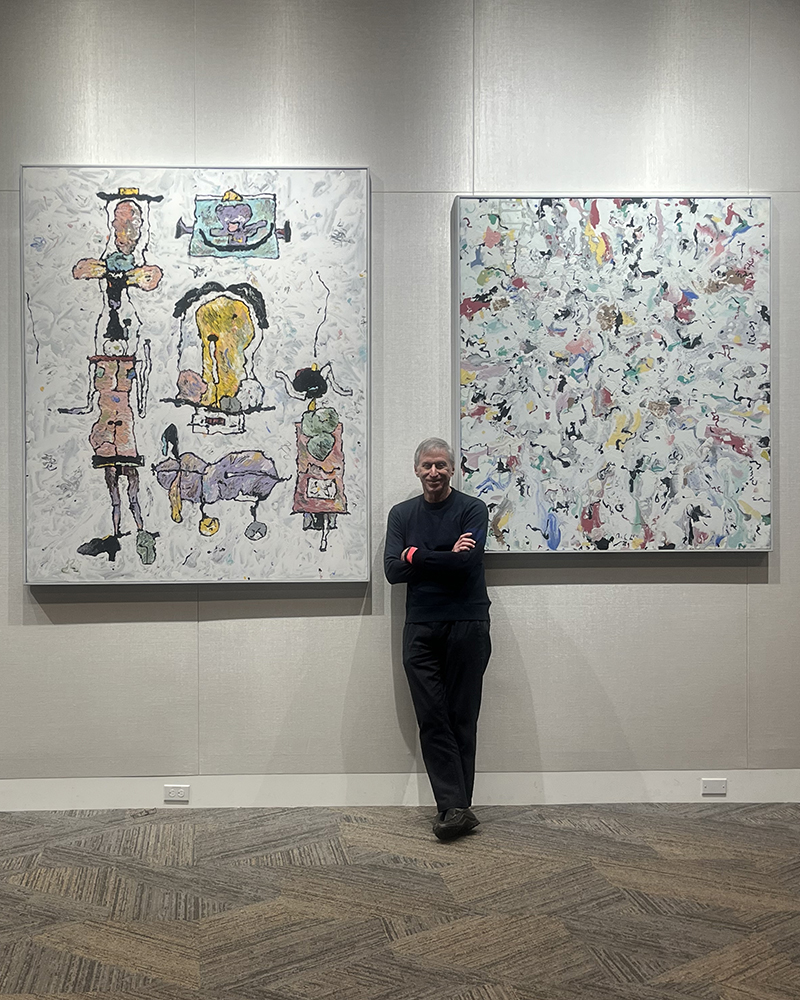
A lesser-known, but nonetheless impressive, feature of both buildings is the artwork Levy personally selected to adorn the corridors and common spaces — work that “tickles the brain,” as Strauss put it. The collection is notable for its celebration of UW-affiliated artists and Pacific Northwest culture, and Levy’s labor of love earned him a place on the UW’s Henry Art Gallery Board of Trustees.
“Every time I walk into one of the buildings, I feel really good about what we did there,” Levy said. “We designed spaces that people want to spend time in while sparking new ideas and high-impact research.”
The space provided by the new buildings also supported a significant growth in student population. The year Levy took the helm, the Allen School awarded 255 degrees; by the time he handed the reins to current director Magdalena Balazinska at the start of 2020, that number had more than doubled to nearly 600. The school has continued on that trajectory, last year awarding an estimated 800 degrees.
Along the way, newcomers have continued to benefit from the tone Levy set during his long spell in leadership.
“Hank placed a strong emphasis on maintaining a collaborative and friendly culture, and this intentional focus ensured that as new faculty and students joined, they were able to quickly integrate into the community,” said Short, who held engineering and leadership roles at DEC prior to joining Microsoft. “This environment enabled everyone to become familiar with ongoing work and to connect with the appropriate colleagues for collaboration. The Allen School still exhibits this culture even as we have over 200 faculty and staff working across so many distinct areas of computer science.”
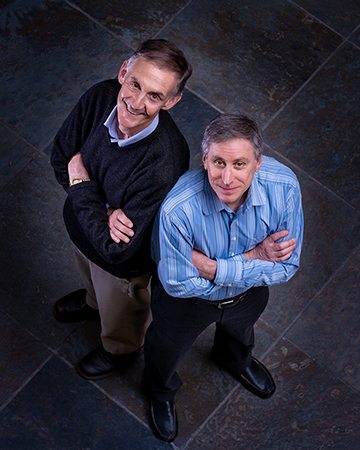
So far, donors have committed more than $1 million to the professorship fund in Levy’s honor. Among them is the person who helped lure him away from DEC in the first place — and who has worked alongside him ever since.
“Hank and I have been partners — perfect partners, really — since the late 1970s. We had complementary skills, which made us an incredibly effective team,” said Lazowska, Professor and Bill & Melinda Gates Chair Emeritus at the Allen School. “Thousands of students, as well as the Allen School, the University, and the tech community, have been the beneficiaries of Hank’s vision and leadership.”
To learn more about Levy’s career and contributions to the UW, read his 2019 interview with GeekWire.
For information on how to contribute to the fund honoring Hank Levy, contact Rebecca Kuenzel Shirley, associate director of advancement, at rkuenzel@uw.edu or make a gift online.