
Research Opportunities
Research is an exciting, and sometimes challenging, process of discovering something completely new.
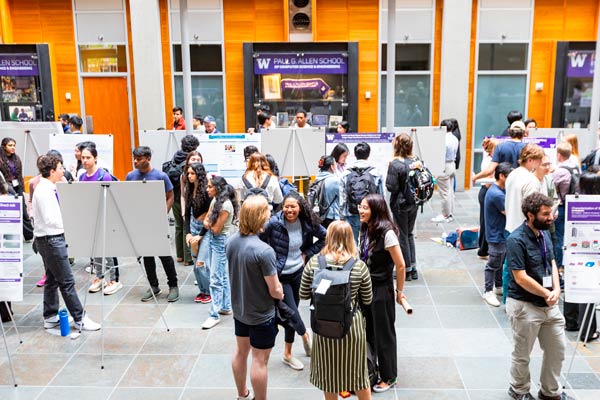
It is also essential to tell the world about your discovery for others to apply or build upon.
Research involves many tasks, such as investigating prior work, inventing, system-building, experimenting, reasoning (proofs), collaboration, writing, and speaking. It is essential to tell the world about your discovery for others to apply or build upon.
Many research projects fail; if there is no chance of failure, it is not research.
Jump To A Section
CSE 394 & CSE 494 Guided Research Program
CSE 394: Introduction to Research in Computer Science and Engineering
This two-credit seminar course introduces students to skills and concepts that enable them to participate in computer science and engineering research. The course also covers the research process, different fields and methods of computing research, habits and approaches of successful researchers, and practical techniques and tools for computing research.
CSE 394 is only offered during autumn quarter, and is the first course in the guided research program. It is a prerequisite for CSE 494. To register, students must complete the registration request form linked in the time schedule. This course will fulfill two credits of CSE electives so long as students have not already reached the maximum allowable credit for specified courses reflected in the CS degree audit (CSE 301, CSE 394, CSE 492, ENGR 321 and/or GEN ST 350).
CSE 494: Guided Research in Computer Science and Engineering
This three-to-four credit seminar provides guided initial research experiences in computer science and engineering. Students are expected to complete the four-credit workload, regardless if they register for three or four credits. Research projects are completed either individually or in small student teams under the guidance of mentors with research experience. A seminar component explores general research guidance and tracks progress.
CSE 494 is only offered during winter and spring quarters, and is the second course in the guided research program. To register, students must complete the registration request form linked in the time schedule. This course is graded as Credit/No-Credit. CSE 494 does not fulfill specific CSE degree requirements.
Finding a Research Project
The following contains information about some (not all) research labs and researchers, and how to get involved with them. Building connections with graduate students and asking them about projects they are working on can also be a good way to learn more about research opportunities.
Research Labs
Individual Researchers
The Process
The process below is applicable to Allen School Undergraduates. Please review the Allen School Research Registration Flowchart for a visual representation of the research registration process.
For non-Allen School students, Allen School students working with affiliate faculty, or non-Allen School faculty, please refer to the process outlined in the “Types of Research”.
- Think about what you would like to research.
- What topics have you enjoyed most? Did you take a class and really liked the style of thinking? How do you approach problems? Are there faculty you would like to learn from and get to know better?
- Occasionally, faculty members and graduate students will advertise research projects for undergraduates. It is not wise to wait for these announcements. Most research positions go to students who have proactively contacted a faculty member or Ph.D. student.
- Additionally, consider signing up for our Undergraduate Research courses, CSE 394 and CSE 494. These are excellent options for students to enroll in guided research.
- The goal of those courses is to give you exposure to research and help you build baseline skills prior to seeking research positions in the Allen School.
- You will get hands-on experience with common research responsibilities for undergraduate researchers and you will hear about exciting research topics in the Allen School.
- See CSE’s research webpage to determine what faculty members are working in your area of interest.
- Some faculty work directly with undergraduates. However, faculty are very busy, so it is more common that undergraduate researchers are directly supervised by a graduate student, with occasional input from the faculty member. Don’t feel disappointed if you work with a Ph.D. student. You will get a lot more attention from that person than you would from a faculty member. In general, unless you already know a Ph.D. student, you should contact the faculty member, who may direct you to talk with a Ph.D. student.
- If a researcher is potentially interested in working with you, they will invite you to an interview. That is an opportunity for both of you to learn about one another and determine whether you have a good research fit.
- After you’ve identified a research topic and have secured a research position, complete the research registration process outlined on the Undergraduate Research Registration page.
Research Funding
Most, but not all, faculty members have funds they can use to pay undergraduates for research. Double-dipping is not allowed: you cannot get both course credit and pay for the same work.
If a faculty member does not have funding for undergraduates, then if they have an NSF research grant, they can apply for an NSF Research Experience for Undergraduates (REU) supplement. You could remind your faculty sponsor about this research opportunity.
This site also gives information about REU programs at other universities for which you may be eligible. The Mary Gates Endowment, the Washington Research Foundation, and the Washington NASA Space Grant Program have research grants for undergraduates.
Departmental Honors and Senior Thesis
For full requirements on how to graduate with departmental honors, please see the Degree Requirements CSE Honors section.
If you want to pursue departmental honors, you should notify your faculty advisor and determine a topic for your senior thesis. The honors research and project should be completed with one faculty member, or, in the rare instance where you need to switch advisors, faculty within the same area of research as the original advisor.
Students typically complete their thesis during their last quarter of research. Once the thesis is completed, one copy should be submitted to the faculty supervisor and one to the CSE undergraduate advisors. If you do not meet the honors thesis requirements, you will not graduate with honors even if you have successfully completed nine credits of research. In many cases, the faculty will not issue grades for honors research until the entire project is finished and approved.
Undergraduate Thesis Archive
All CSE honors theses, including the past winners of the Best Senior Thesis Award, are published online as part of the UW CSE Undergraduate Thesis Archive.
Cross-Departmental Research Opportunities
Students who wish to participate in research opportunities outside of CSE can only count research credits towards their CSE degree if it is arranged with a CSE faculty or approved by the Undergraduate Program Chair. Refer to the Research Registration Flowchart and discuss your questions with an adviser for more information. Credit types, amounts, and grading would then be worked out between the faculty sponsor, the student, and the research advisor in the other department. This should be arranged prior to beginning a project.
Frequently Asked Questions
What is undergraduate research?
The main reason is because you enjoy problem-solving and discovery. You should work on problems you really care about. If you try to force yourself to pursue a research project just to put it on your resume, you are unlikely to have the perseverance to succeed.
Research is a way to deepen knowledge in a specific subfield, especially if you have already taken all the relevant classes.
Experience in research usually transfers to your career. If you are lucky, your job will involve unique challenges. It may require you to refine vague or ill-posed questions, to experiment with different approaches, and to clearly communicate your findings to others in your company.
You might want a career in research. The best way to find out whether you like it is to do it. If you are interested in a PhD, which requires significant research over many years, then you should definitely do research to ensure you will enjoy it and to strengthen your grad school application. Some people who were not interested in research as a career have found that they enjoyed it and changed their plans.
Why should I get involved in research?
The main reason is if you want to see what research looks like as a career / think you may want a Ph.D. Undergraduate research is (unsurprisingly) one of the best ways to experiment with research as a career path.
Undergraduate research is an experience that is also sometimes transferrable to industry – some subfields, especially in machine learning, HCI, and ubicomp will be programming-heavy and can demonstrate experience for SWE roles.
How can I apply?
Before you apply, understand the following questions:
What subfield am I interested in? Do I want to work on something specific (e.g. improving mobile communication access for rural communities) or something broad (e.g. exploring HCI as a subfield)?
Why am I interested in doing research? Maybe you’re interested in research to a) try it out, b) explore a new subfield, or c) deepen knowledge in a subfield you’re interested in.
How has my prior experience clarified my interests and passions? Did you take a class and really liked the style of thinking? How do you approach problems?
Start at Finding Research – some faculty and labs already have an established pipeline for applicants. If you are interested in theory, the process is slightly different since there are fewer theory researchers. Your best bet is reaching out directly to faculty within this research area with some topics of interest, and continuing to take theory-related courses.
What are the prerequisites for research?
This will depend a lot on the subfield you are interested in. Here are a few sample research subfields and the type of work you might encounter:
Human-Computer Interaction: HCI researchers ask, how do humans use computers? How can we make those interactions more seamless? Better for people with disabilities? HCI research often will involve coding, user studies, and data analysis.
Machine learning/robotics: ML/robotics researchers ask, how can we teach computers to learn? What techniques does the literature use, and how can we improve on that? ML/robotics research will often be coding-heavy and may involve matrix calculus/linear algebra. Taking CSE446 (ML) and math coursework is often recommended.
Computational/synthetic biology: comp/synth bio researchers ask, how can computational techniques advance our understanding of biology? This field is broad and may require prior knowledge of biology or an aptitude to read papers from both computer science and biology. Research may look like work in the wet lab, data analysis/visualization, or coding.
Theory: theory researchers ask, what can we prove using math? Theory often stands alone from other research areas in that coding is infrequently needed – most of the work is reviewing literature and proving theorems. Strong performance in CSE311/421, high level math coursework, or taking graduate-level theory courses is recommended.
This is not a complete list of subfields, and every subfield is different!
Positions will usually outline the prerequisite courses or skill sets that are expected, so use those to gauge whether you would be a competitive applicant for the position. Otherwise, you can always reach out to the faculty or graduate students you are interested in working with to see if there are other openings that match your background better.
Other ways to learn?
Research is one way to explore a new field, but there are others.
Take advanced classes, including graduate classes. These are often open to undergraduates who have exhausted the undergraduate classes in an area. Again, you will need to ask permission to register, but don’t be shy about asking. a lot on the subfield you are interested in. Here are a few sample research subfields and the type of work you might encounter:
Attend colloquia, which brings researchers from within and outside UW to explain their latest discoveries. Most colloquia are available from the CSE YouTube channel.
Attend research seminars, which are classes numbered CSE 590. For some 590 seminars, you will read and discuss a paper each week. (This might seem daunting, but you will get the hang of it!) For the other 590 seminars, you just need to show up and listen to a talk. 590 seminars require permission of the instructor to attend, but don’t be shy about asking.