
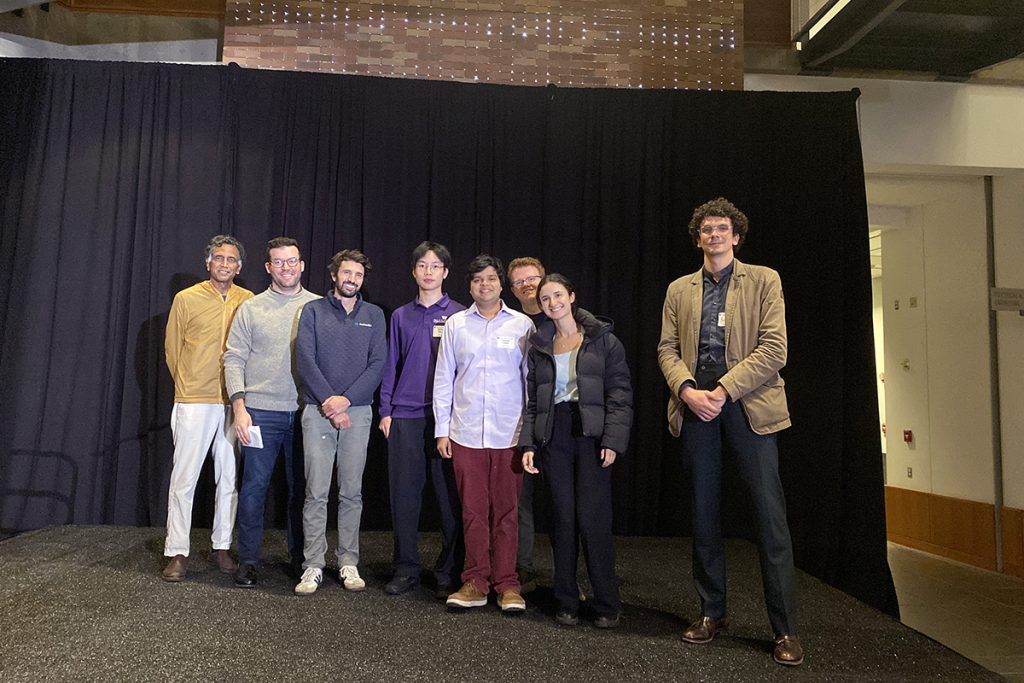
A new method for shrinking artificial intelligence models so they can run on small, low-power chips. Benchmarks for testing how well video language models can tell the difference between various dance steps. A framework for safeguarding DNA synthesis against potential cyberbiosecurity threats. And a novel approach for using AI agents to automatically generate customized computer systems.
These are just a sample of the more than 50 projects on display at the Allen School’s 2026 Research Show and Open House. Around 200 Industry Affiliate partners, alumni and friends came together on the University of Washington campus last month to participate in technical sessions covering topics ranging from transparent and equally beneficial AI to security in the age of AI, explore the evolution of computer science education with Allen School faculty, learn about researchers’ efforts to “future-proof” machine learning systems, and more.
Building machine learning systems in the age of AI
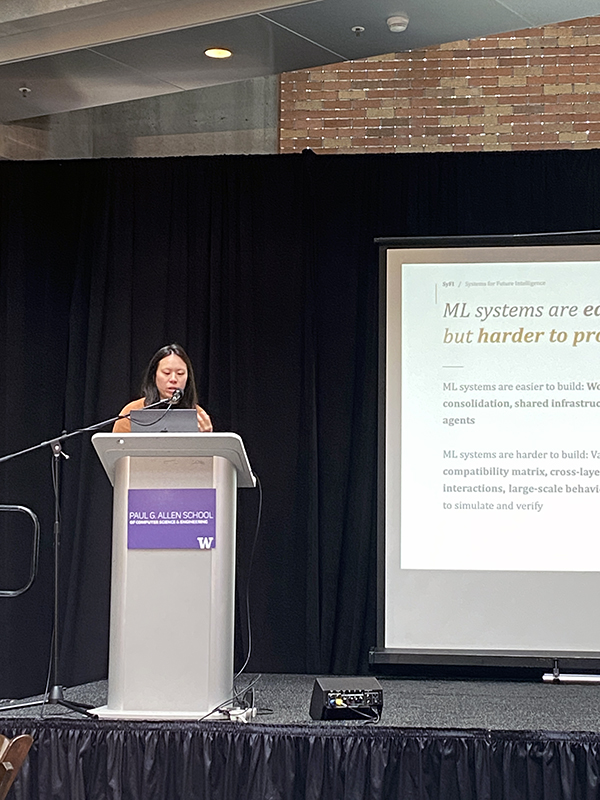
In her luncheon keynote, Allen School professor Stephanie Wang shared recent research from the SyFI Lab (Systems for Future Intelligence) that highlights how building machine learning systems is changing in the age of artificial intelligence.
For Wang, while AI coding agents have it easier to prototype ML systems, productionizing them is much harder. This is because building complex systems requires searching over a massive design space. To do this efficiently and reliably, an agent needs dense and timely feedback, the ability to reason about behavior without having to run the system on each code change, and abstractions that let an agent explore and find novel designs — in other words, the same things that human engineers need.
“The mission of our lab is to find exactly these kinds of abstractions. We want to enable future-proof AI systems infrastructure that’s adaptable, scalable and cross-cutting on the stack,” said Wang.
One of the main research questions Wang and her collaborators aim to address is how to redesign ML systems to make them more amenable to AI-driven optimization. Their answer: Piper, a programmable distributed training system. Piper takes all of the different parts of system execution that are normally baked into a specific implementation and “exposes them as programs, so that you can then have a coding agent actually explore them,” Wang explained. By building a generic system core that can execute any user schedule, Piper achieves a similar or better performance compared to existing systems, while also supporting novel schedules that are difficult for these existing systems to implement.
The lab’s other main research question explores what kind of environment is needed for this fully autonomous optimization. In the context of inference systems, the multi-agent system VibeServe “rethinks what a serving system should look like now that we have these more advanced coding agents,” said Wang. Generic LLM serving stacks are able to effectively cover mainstream use cases, but struggle with novel models, accelerators and workloads. Instead, VibeServe’s approach generates a bespoke serving system for each combination of workload and hardware, with up to six times better performance compared to the next-best baselines. Recent results show further improvements by integrating more advanced tools for the agent to use, such as ServingStudio for simulation and profiling.
Next, Wang and her collaborators hope to push both Piper and VibeServe further by developing fully evolvable abstractions to enable more reliable and efficient search as well as benchmarks for generating ML systems from scratch.
Celebrating student innovation: 20 years of the Madrona Prize
The event culminated with the Allen School’s annual poster session and announcement of the Madrona Prize. Since 2006, Madrona Venture Group has honored innovative student research projects with commercial potential, with past winners going on to raise hundreds of millions of dollars in venture capital and build companies that have been acquired by the likes of Google.
Chris Picardo, partner at the firm, announced the prize winner and two runner-ups.
“This is the 20th anniversary of the Madrona Prize,” said Picardo. “We’ve been thrilled to be able to be a part of this for so long.”
Madrona Prize Winner / AI iteratively Optimizing AI via Real Hardware Feedback
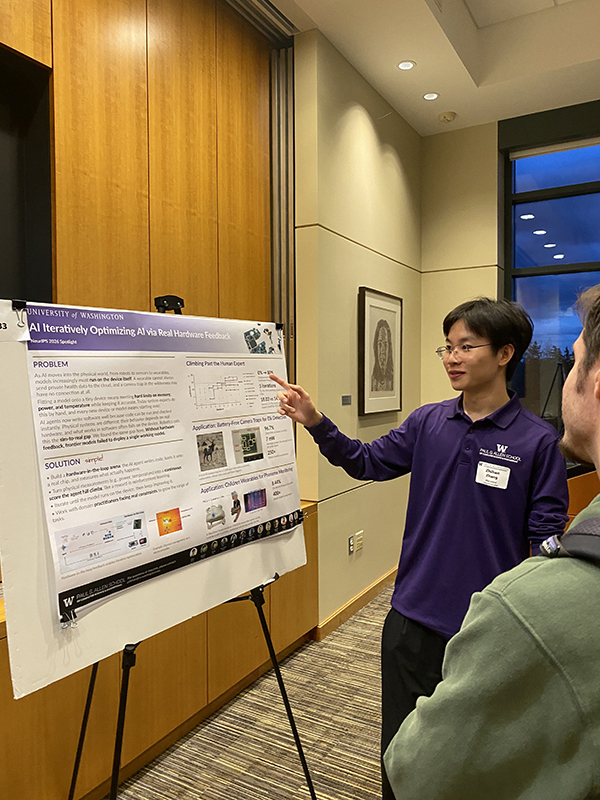
Allen School Ph.D. student Zhihan Zhang accepted the grand prize for “AI Iteratively Optimizing AI via Real Hardware Feedback.” For AI to operate effectively in the physical world and benefit society — for example, running on small wearables for monitoring health, or remote camera traps for detecting wildlife — it needs real feedback from the environment in which it operates to learn what actually works.
Zhang and his collaborators introduced a “hardware-in-the-loop” approach that enables AI agents to optimize the performance of on-device models within hard constraints such as memory, power and temperature based on physical feedback from real hardware. Without this feedback, the team found that leading AI models failed to produce a working result; with it, the AI agent was able to beat a human expert within seven rounds. The approach could extend to autonomous laboratories in the physical sciences, where AI agents interact with physical instruments to conduct experiments and optimize real-world systems.
“Just as AI agents learn to write better software by running and testing code, they can learn to build better physical systems by measuring how those systems actually perform on real hardware,” said Zhang. “By closing this feedback loop, we can bring the same powerful AI capabilities we’ve seen in the digital world into the physical world.”
The researchers released their platform, Embedded Arena, as open-source code.
Additional members of the team include Allen School professors Kurtis Heimerl, Vikram Iyer, Natasha Jaques and Shwetak Patel; Allen School Ph.D. students Chun-Cheng Chang (B.S., ‘25) and Emmanuel Azuh Mensah; Allen School research assistant Jiayi Shao; Alexander Metzger (M.S., ‘26), Ph.D student at UC Berkeley; Jiuyang Lyu (M.S., ‘26), Ph.D. student at Georgia Tech; Yujia Liu, Ph.D. student at UC San Diego; Edward Wang, faculty at UC San Diego; and Gregory D. Abowd, faculty at Northeastern University.
Madrona Prize First Runner-up / VideoNet: Action Recognition in the VLM Era
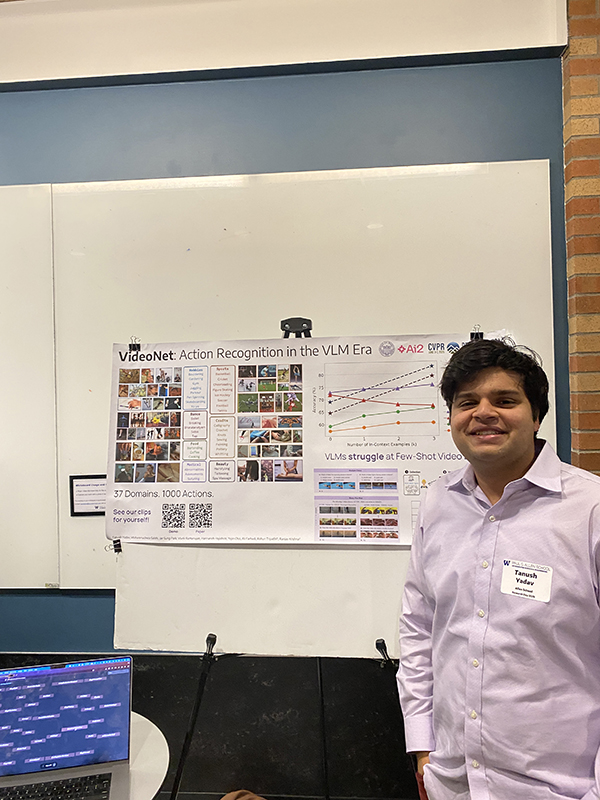
Allen School researchers also received accolades for “VideoNet: Action Recognition in the VLM Era,” a comprehensive benchmark covering 1,000 actions across 37 domains for testing how well video language models can distinguish between specific movements — from a precise surgical suture to a tap dancer’s nuanced step.
Using VideoNet’s binary few-shot evaluation, the team found that compared to humans and also LLMs, VLMs struggle with learning by example. After being shown three examples of a figure skating jump, people improved their accuracy by almost 14 percentage points, while on average VLMs improved by about 3 percentage points.
“While models can clearly define these domain-specific actions in text, they struggle to recognize them in video form,” said Ph.D. student Tanush Yadav, who accepted the award on behalf of the team. “Our long-term goal is to teach models to recognize — and even critique — these actions, so they can help humans learn new hobbies. For instance, imagine if a model could give a new gym-goer pointers on their deadlift form.”
The team also includes Allen School professors Ali Farhadi, Hanna Hajishirzi and Ranjay Krishna; former Allen School faculty member Yejin Choi, now at Stanford University; Allen School Ph.D. student Mohammadreza Salehi, Jae Sung Park (Ph.D., ‘26), now at the Allen Institute for AI (Ai2); Vivek Ramanujan (Ph.D., ‘26), now at Anthropic, and Rohun Tripathi, research scientist at Ai2.
Madrona Prize Second Runner-up / Secure Screening for DNA Hardware
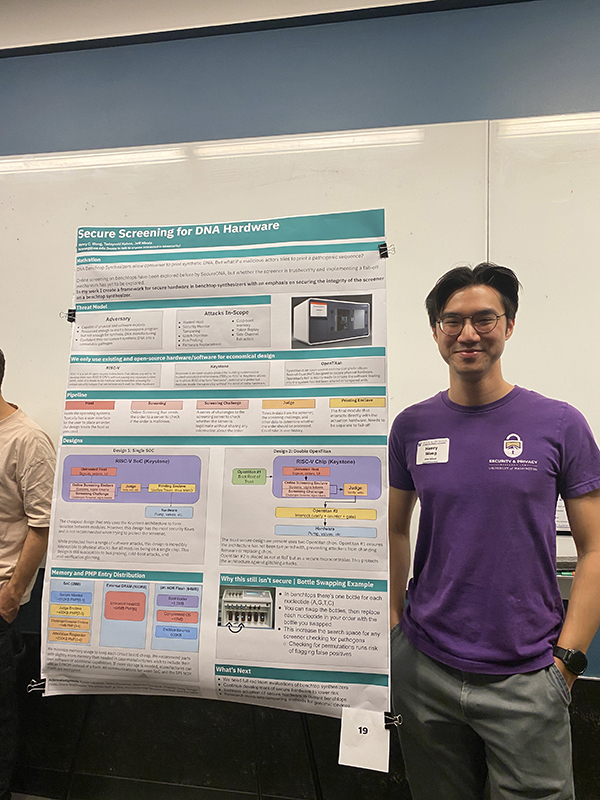
Another research team was recognized for “Secure Screening for DNA Hardware,” which proposes a framework for securing the screening software on DNA benchtop synthesizers meant to stop adversaries from printing dangerous pathogens.
“The fear is that bad actors can synthesize something malicious, like an engineered pathogen. Ideally we put some sort of screener inside the benchtop DNA synthesizer, but little work has questioned if the device is secure itself,” said Allen School Ph.D. student Henry Wong, who accepted the prize. “Without security, bad actors can just skip the screener by tampering with the machine. This work is not only a suggestion for secure architecture on benchtops, but also an open call for work on the security of these newly capable genomic devices.”
The team found that even the most secure hardware could still be susceptible to tampering from adversaries. For example, an adversary could physically move around the bottles containing each nucleotide in the device, increasing the search space for any screener checking for pathogens.
Wong developed the project working alongside Allen School professor Jeff Nivala and former faculty member Tadayoshi Kohno, now at Georgetown University.
People’s Choice Award / VibeSys: Self-Improving Bespoke Systems
The evening concluded with the announcement of the People’s Choice Award, where attendees got the chance to vote for their favorite poster or demo.
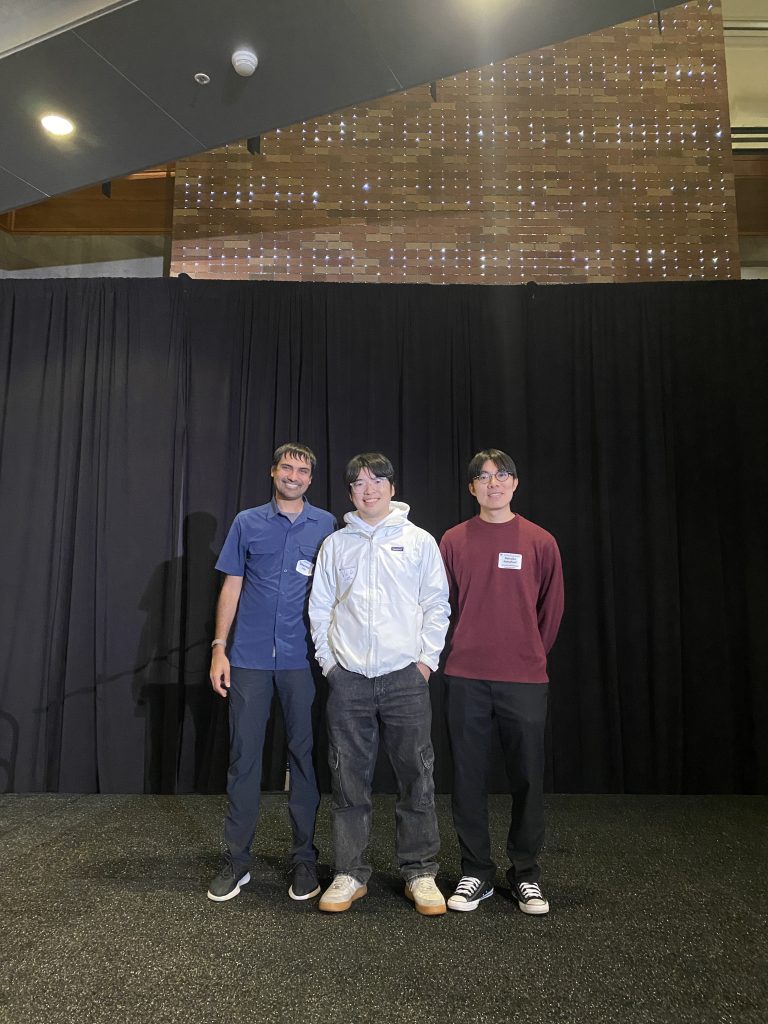
Professor Shwetak Patel, the Allen School’s associate director for development and entrepreneurship, presented the award to Ph.D. students Keisuke Kamahori and Shihang (Vic) Li for their work on VibeSys. VibeSys offers an agentic framework that generates systems to support evolving workloads and hardware configurations in place of expensive manual specialization.
“We introduced VibeSys, our vision for a new approach to computer system design in which AI agents automatically build and continuously optimize systems tailored to specific needs,” said Kamahori. “As a first step toward this vision, we developed VibeServe, which automatically builds customized systems for serving LLMs based on the model’s architecture, workload patterns and the hardware backend.”
The team has demonstrated VibeServe’s capabilities on AMD and Amazon’s Trainium chips, generating customized systems that were able to outperform the existing open-source alternatives. Next, the researchers plan to develop a formal verification engine for better trustworthiness, and integrate a simulation framework into the VibeSys pipeline to improve development speed.
The team behind VibeSys also includes Allen School professors Baris Kasikci and Simon Peter.
For more about the Allen School’s 2026 Research Showcase and Open House, read GeekWire’s coverage and the Madrona Prize announcement, and view the luncheon keynote on the Allen School’s YouTube channel.