
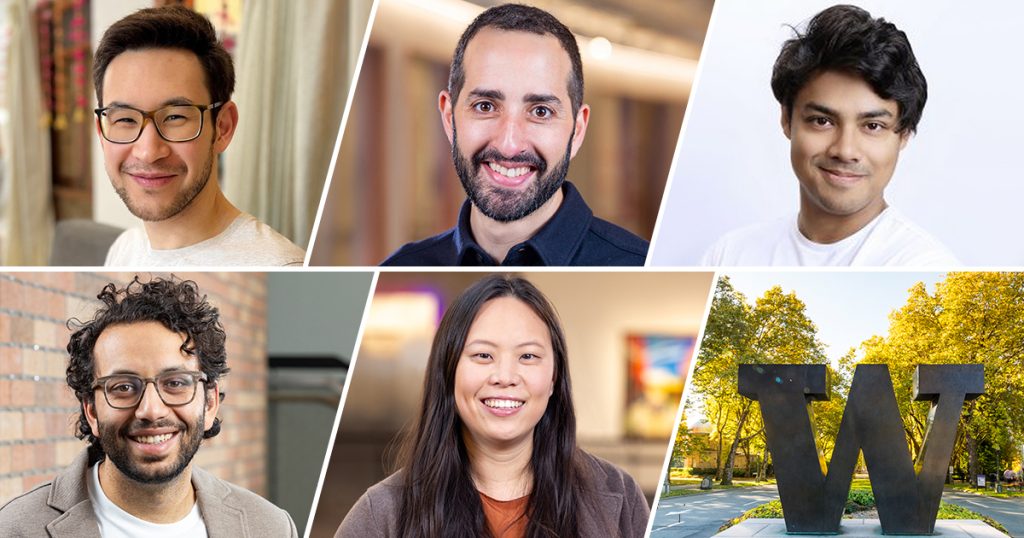
For early-career researchers, a CAREER Award from the U.S. National Science Foundation (NSF) is both a prestigious honor and a significant source of support for advancing the state of the art in their respective fields. The five Allen School faculty members who are among this year’s awardees are shaping the future of computing on a variety of fronts, from designing new video-language models that can grasp subtle differences in movement, to understanding the neural mechanisms of learning to build artificial intelligence models that learn more like biological brains do — and more through projects spanning systems, cryptography and quantum computing.
Andrea Coladangelo: Quantum cryptography: Towards new functionalities and foundations

Quantum computers have the potential to fundamentally change the field of cryptography, explained Allen School professor Andrea Coladangelo. By efficiently solving problems such as factoring and computing discrete logarithms, quantum computers threaten the security of today’s widely-deployed encryption schemes. Additionally, the ability to leverage quantum information opens the doors to realizing cryptographic functionalities that are not attainable with only classical capabilities.
With his CAREER Award, Coladangelo will investigate the interplay between quantum information and computational hardness, a key resource that powers virtually all of today’s cryptography. He proposes to develop new techniques that enable new cryptographic functionalities and forms of security — such as copy-protection of software, and ciphertexts that cannot be duplicated. Coladangelo will also investigate the computational hardness of inherently quantum problems as a new foundational resource for cryptography.
“One of the fascinating aspects of quantum information is that it enables forms of cryptography that are fundamentally impossible in the classical world,” said Coladangelo, who co-leads the Allen School’s Quantum Group.
“Over the next five years, the broad goal of this research is to advance our understanding of how uniquely quantum phenomena, such as entanglement and the uncertainty principle, can be leveraged to build entirely new forms of cryptography and to verify the capabilities of future quantum devices,” he continued.
Coladangelo is also interested in leveraging cryptographic techniques towards demonstrating quantum advantage. The term refers to a computational test that a quantum computer can verifiably pass efficiently, but a classical device cannot. With his research, Coladangelo aims to bring us closer to attaining this milestone in quantum computation.
Matthew Golub: Dissecting and guiding neural population mechanisms of learning
The ability to learn is crucial for both humans and AI. People learn how to reason, communicate and even recover skills after an injury. However, “as a field, we know remarkably little about the neural mechanisms that drive those changes in the brain — for example, how quickly they operate and how flexibly they can reshape neural activity,” explained Allen School professor Matthew Golub, who directs the Systems Neuroscience & AI Lab (SNAIL) at the University of Washington.
With his CAREER Award, Golub aims to understand how neurons change their coordinated firing activity during learning and develop ways to guide these learning processes to proceed more quickly and effectively.
Inside the brain, learning requires populations of neurons to modify their coordinated neural activity. A neural population’s activity is governed by inputs it receives as well as local recurrent dynamics. This means modifications to the inputs and local dynamics make up the two key population-level mechanisms of learning. Golub will investigate how neural circuits change over short-term versus multi-day learning, with a focus on the primary motor cortex. As part of this work, he is pioneering an approach that combines computational models of neural populations with brain-computer interface learning experiments in monkeys to establish a framework for identifying circuit-level mechanisms of learning.
By revealing the mechanisms that support learning in the brain, this research may improve methods for guided skill training, inspire the development of robust, efficient and interpretable AI systems that learn more like biological brains, and more.
“One of the long-term motivations for this work is neurorehabilitation: If we can understand why some patterns of brain activity are easy to change and others are difficult, we may be able to design better ways to help people recover skills after injury or disease,” said Golub. “This project is a step toward making learning in the brain something we can not only observe, but intentionally guide.”
Ranjay Krishna: Open and grounded video-language models

Videos can capture subtle distinctions in human action — say, a surgeon’s precise sutures or a dancer’s nuanced footwork — that video-language models may not be able to pick up on. Although modern AI systems excel at static visual tasks, they struggle with reasoning over dynamic long-form video such as tracking objects over time or explaining how events unfold.
Allen School professor Ranjay Krishna received a CAREER Award to develop a new class of open-source video-language models that can either match or go beyond the capabilities of today’s proprietary models. Compared to existing models that tokenize videos uniformly, only decode text and operate over fixed inputs, Krishna will tackle core technical limitations across tokenization, decoding and encoding.
“While video-language models can now recognize coarse events like a ‘basketball throw,’ they still struggle with fine-grained, meaningful actions like distinguishing a layup from a jump shot,” said Krishna, who co-directs the Reasoning, AI, and VisioN (RAIVN) Lab. “At its core, the research advances a new framework for temporal and spatial grounding — enabling models to track entities over time, understand causal interactions, and produce structured outputs such as trajectories, segmentations and event descriptions.”
As part of this work, Krishna proposes to introduce three innovations: a trajectory-based grounded video tokenization strategy, flexible encoder architectures for processing multiple videos at varying resolutions and a multimodal decoder for both spatial and textual outputs. These innovations will form the framework for understanding complex real-world video data and lead to new capabilities in few-shot reasoning, multi-video understanding and multimodal grounding.
Krishna’s research will enable video-based AI systems that can support practical applications in robotics, scientific analysis, education and more. For example, video-language models that can understand dynamic content are essential to assistive video analysis, such as describing surveillance footage or instructional videos, as well as embodied AI, which is where robots interpret and then act on visual instructions.
Chinmay Nirkhe: The computational complexity of many-body entanglement
Quantum many-body systems often exhibit entanglement, where particles become interconnected in a way that makes their quantum states impossible to describe independently. This entanglement pattern can make tasks such as predicting outcomes or certifying device behavior computationally prohibitive.
Using tools from theoretical computer science, Allen School professor Chinmay Nirkhe aims to further our understanding of the computational complexity of entanglement in many-body systems. His CAREER Award-winning project will focus on the description complexity of the ground states of local Hamiltonians. By mapping when these different states can be efficiently described, verified or cloned, Nirkhe seeks to identify the structural principles that govern complex entanglement in physically realizable systems.
“A central goal of quantum computation is to improve our understanding of many-body physics, including the quantum states that arise from local physical interactions,” said Nirkhe, who co-leads the Quantum Group. “We know that random quantum states are extraordinarily complex, but the states we care about in physics are not random; they are shaped by local physical interactions. The main question is whether this structure is enough to make them computationally simple.
“Indeed, in some special cases, this structure can be exploited to give efficient classical algorithms for approximate simulation and analysis. But local structure does not always imply computational simplicity, and some of my prior work demonstrates evidence for this,” he continued.
The insights gleaned from this project are expected to influence a variety of fields, from theoretical physics to engineering. For example, in quantum cryptography, hardness assumptions based on quantum phenomena can enable new forms of secure computation. With the growing capabilities of near-term quantum devices, whose behavior probes entanglement patterns that are classically intractable, Nirkhe’s research will become more and more timely.
Stephanie Wang: A distributed tensor runtime for fast, flexible, and scalable machine learning
Today’s AI systems depend on distributed computing, where thousands of specialized chips work together to split up the math required to run extremely large models. However, as these models grow larger, it becomes increasingly difficult to coordinate both how these computations should be divided up and how data moves across machines.
Allen School professor Stephanie Wang will use her CAREER Award to bridge this gap by developing a new open-source software system that will enable these machines to run more efficiently and with more flexibility.
“The system is designed to adapt to changing conditions, such as varying workloads or hardware failures, while still maintaining high performance,” said Wang, who co-directs the UW’s SyFI Lab (Systems for Future Intelligence). “By making it easier to run complex artificial intelligence applications, this work will support the next generation of intelligent technologies in a reliable and efficient way.”
Her project will advance the design of distributed machine learning systems in two key areas. First, she seeks to develop a general purpose distributed execution engine for accelerators. Instead of isolating core system functions such as task scheduling, communication optimization and memory management into distinct software layers, the execution engine will unify and optimize them simultaneously.
Wang then will build off of this system to design a flexible programming model. By incorporating techniques such as just-in-time compilation, which translates source code while the program is running rather than prior to execution, the model will allow users to express a range of parallel execution strategies while enabling the system to employ both static and dynamic optimizations. Together, these components enable a unified distributed runtime to support diverse workloads with high performance across a variety of large-scale computing environments.
Learn more about the NSF CAREER program here.