

The Allen School has recognized alumni Miranda Wei (Ph.D., ‘25) and Chenzhi Zhu (Ph.D., ‘25) with 2025 William Chan Memorial Dissertation Awards, which honors outstanding doctoral dissertations and is named in memory of the late graduate student William Chan.
Wei and Zhu each tackled emerging digital threats as part of their dissertation research. As a member of the Allen School’s Security and Privacy Research Lab, Wei identified new methods for addressing online harassment and abuse. Zhu, a member of the Cryptography Group, introduced more secure techniques for generating digital signatures.
Miranda Wei: A sociotechnical approach to combatting online abuse
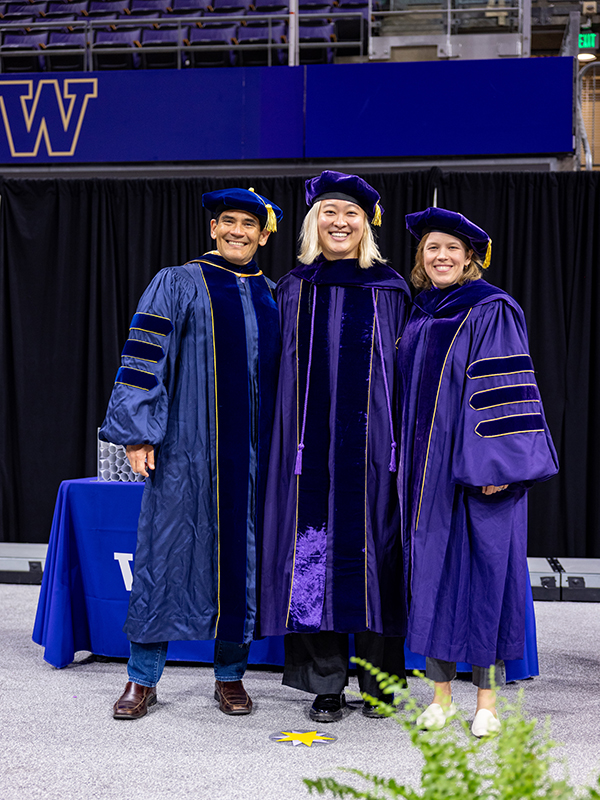
From toxic social media content to image-based sexual harassment, technology-facilitated abuse (TFA) is a growing issue across the globe. However, across the current TFA mitigation landscape, prevention advice focuses on individual approaches. This puts an undue burden on those experiencing online harassment and abuse, explained Miranda Wei, currently a postdoctoral fellow at the Center for Information Technology Policy (CITP) at Princeton University and incoming faculty at the École Polytechnique Fédérale de Lausanne (EPFL) in Switzerland.
In her dissertation titled “Against Online Abuse and Toward Sociotechnical Security & Privacy,” Wei instead advocates for a sociotechnical approach to combat TFA, which integrates people’s lived experiences and social perspectives into computer security and privacy.
“One of the main challenges my dissertation aims to address is to demonstrate the broad range of security and privacy risks that people face, especially online abuse that was historically understudied in this field,” Wei said. “By using data from social media, and incorporating approaches from computer security and privacy like threat modeling (systemically modeling the attackers, their motivations, techniques, and what they’re targeting), my dissertation provides nuanced accounts of online abuse for security and privacy research.”
Wei applied sociotechnical threat modelling to characterize emerging forms of online abuse. For example, within relationship and parenting subcommunities on TikTok, creators share advice on how to surveil or control others. Their methods include tracking a target’s location using AirTags or obtaining their communications by hijacking social media accounts. The perpetrators’ motivations were shaped by social factors such as gender and even TikTok culture. By documenting these techniques, designers and developers can be more aware and anticipate these deeply personal motivations and how their apps and hardware can be misused.
She also found that sociotechnical approaches can also help researchers tackle the growing threat of students generating synthetic nonconsensual explicit imagery, or “deepfake nudes.” She interviewed middle and high school teachers to better understand the potential motivations for this form of TFA, as well as possible interventions in the school setting. Teachers anticipated that motivations would include gender and sexual abuse, “showing how interpersonal violence and trauma manifest in technologies ostensibly with non-abusive intentions,” Wei explained.
One of the main challenges my dissertation aims to address is to demonstrate the broad range of security and privacy risks that people face, especially online abuse that was historically understudied in this field.
As part of her work, Wei mapped out how researchers can use sociodemographic factors such as gender to measure differences in security and privacy behaviors. Through a survey of users in the U.S., Wei established that gender stereotypes surrounding computer security and privacy can negatively impact users. For example, participants believed that women were more likely to be gullible and emotional, as well as make poor security and privacy choices; they perceived men to be more engaged in the topic and more likely to take protective actions such as using two-factor authentication (2FA).
The lesson here, Wei says, is that researchers need to take such stereotypes into account when designing security tools.
“Miranda’s dissertation establishes her as a leader in the emerging field of sociotechnical computer security,” said Allen School professor Franziska Roesner, who co-advised Wei alongside former Allen School faculty member Tadayoshi Kohno. “In short, her dissertation sets a new bar for computer security dissertations that consider the human context.”
Prior to receiving the William Chan Memorial Dissertation Award, Wei earned the John Karat Usable Privacy and Security Student Research Award and a Google Ph.D. Fellowship.
Chenzhi Zhu: Practical and efficient digital signatures for emerging applications
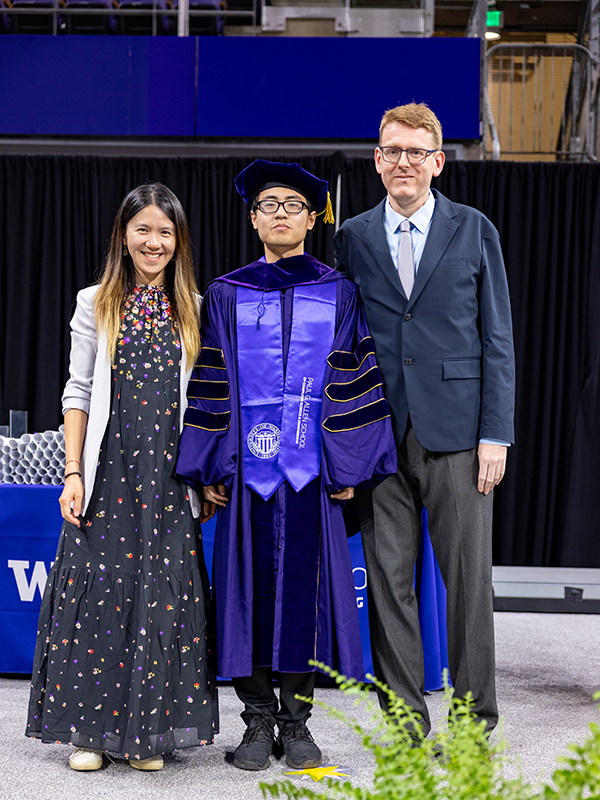
Digital signatures are fundamental cryptographic tools used across multiple applications, from financial transactions to software distribution, to deter any forgery or tampering. While there are many efficient signature schemes with fast signing and verification, emerging scenarios such as digital wallets are requiring more and more advanced protocols for generating digital signatures.
Previous researchers have focused on blind signatures and threshold signatures. The former allows users to obtain signatures without revealing the messages or resulting signatures to the signer, while the latter distributes the secret signing key among multiple signers that interact to produce a valid signature.
In his dissertation titled “Efficient Blind Signatures and Threshold Signatures from Pairing-Free Groups and Lattices,” Chenzhi Zhu, now a postdoctoral fellow at the CIS Lab at NTT Research, builds on these approaches to design efficient cryptographic schemes in both pairing-free groups and lattices. Constructions in pairing-free groups are attractive for their compact key and signature sizes along with their well-established library support. On the other hand, lattice-based constructions are conjectured to remain secure even against quantum adversaries.
“The dissertation advances the frontier of practical constructions of threshold signatures and blind signatures based on pairing-free groups (elliptic curves), as well as lattice-based threshold signatures that provide post-quantum security,” said Zhu. “In particular, its results on threshold signatures have had a direct impact on recent standardization efforts.”
Zhu resolved a problem with blind signatures that had remained unresolved since the 1990s by introducing the first efficient and concurrently secure construction that is pairing-free. In particular, the scheme is provably secure under the discrete logarithm (DL) assumption in the algebraic group model (AGM) and the random oracle model (ROM). Unlike the prior insecure construction that relies on the hardness of the ROS problem, which was shown to be efficiently solvable, the security analysis of Zhu’s construction utilizes a new variant of the ROS problem, called weighted fractional ROS, which is proven to be unconditionally hard.
In addition to his work on pairing-free blind signatures, Zhu introduced a new syntax and security hierarchy for analyzing partially non-interactive threshold signatures such as FROST, a state-of-the-art threshold signature in pairing-free groups. His dissertation provides the first security proof for FROST in the ROM under the algebraic one-more discrete logarithm (AOMDL) assumption — showing that it achieves stronger security than previously considered. He further analyzed two other, more efficient FROST variants and found that they achieve weaker security than the original FROST in the hierarchy. His analysis of the original FROST now forms a core part of the ongoing FROST submission to the National Institute of Standards and Technology (NIST) threshold call.
The dissertation advances the frontier of practical constructions of threshold signatures and blind signatures based on pairing-free groups (elliptic curves), as well as lattice-based threshold signatures that provide post-quantum security.
Zhu’s work also has shaped the growing line of research on post-quantum secure threshold signatures from lattices. Previous lattice-based constructions were either based on heavy cryptographic tools — such as fully homomorphic encryption — that leave these schemes impractical, or relied on non-standard assumptions. He established the first security analysis for a state-of-the-art two-round lattice-based threshold signature scheme that does not rely on any heavy tools under standard lattice assumptions. The result further influenced the Tanuki and Hermine submissions to the NIST threshold call, in which they both rely on Zhu’s analysis to establish security under the standard assumptions.
“Chenzhi’s dissertation made important contributions to a highly active area of cryptography, developing rigorous foundations for mechanisms with broad relevance across modern digital infrastructure,” said Stefano Tessaro, who co-advised Zhu alongside colleague Rachel Lin. “What sets his work apart is the rare combination of theoretical depth, conceptual clarity, and practical impact, with results that have already influenced standardization efforts and shaped subsequent work in both academia and industry.”
Learn more about the William Chan Memorial Dissertation Awards here.