When imagining the future of technology, sometimes all we need to do is look out the window — or into a microscope.
Our researchers take inspiration from nature to redefine what a computer can be, from data storage using synthetic DNA, to sensors modeled on insects and leaves. We also advance technologies to help solve biology’s biggest mysteries, such as computational approaches for understanding the mechanisms of disease and brain-computer interfaces that can restore or augment physical function and mobility.
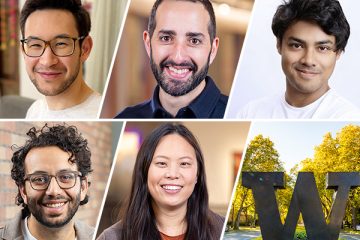
Professors Andrea Coladangelo, Matthew Golub, Ranjay Krishna, Chinmay Nirkhe, and Stephanie Wang are shaping the future of computing through projects spanning AI, systems, computational neuroscience, cryptography and quantum computing.
Itani, who works with Allen School professor Shyam Gollakota in the Mobile Intelligence Lab, was recognized for exceptional early-career research advancing AI systems for “superhuman” hearing.
A technology known as semantic hearing developed in Allen School professor Shyam Gollakota’s lab could let users create acoustic bubbles, isolate chosen voices, and control individual sounds in their environment.